Essential Thai Vocabulary for Your Thailand Trip
Learning a few Thai words can transform your journey. Discover basic vocabulary, pronunciation tips and essential expressions for traveling in Thailand.
Although most Thai people speak English fluently, it's always better to know some basic Thai vocabulary. Not only can this help you if you travel off the beaten path, but it will also allow you to connect with locals. And you'll be surprised to see how much Thai people appreciate tourists who make the effort to speak a few words in their language! Discover the survival guide vocabulary for a trip to Thailand…
1. An ultra-complex alphabet
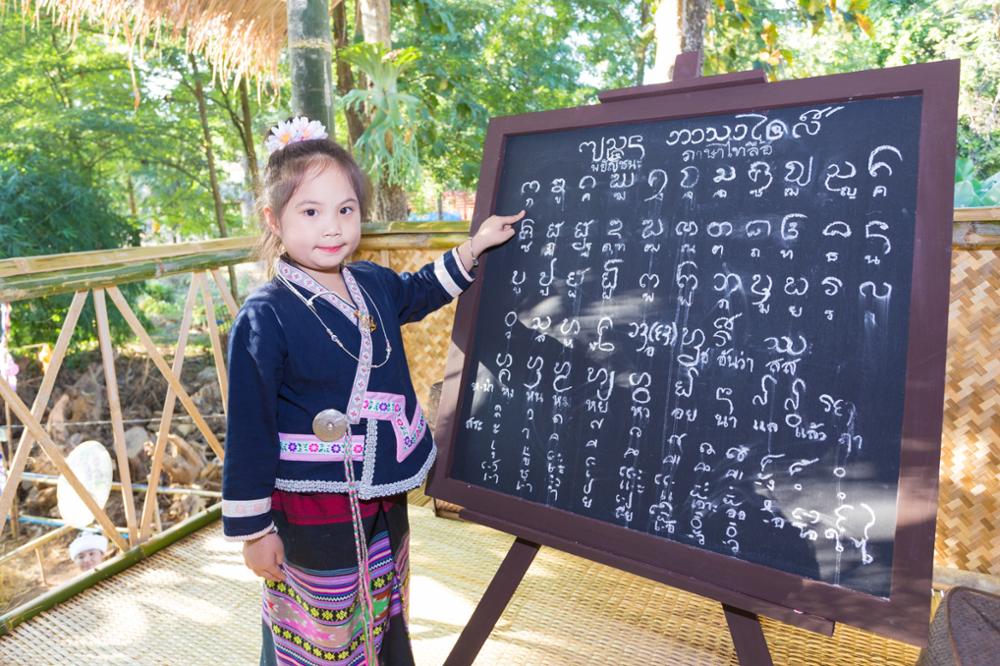
We won't sugarcoat it—the Thai language is far from easy. With Khmer and Chinese influences as well as some Pali and Sanskrit elements, Thai bears little resemblance to Romance languages. The Thai alphabet consists of 44 consonants, 18 basic vowels and 19 diphthongs. It's a language spoken in 5 tones (neutral tone, low tone, falling tone, high tone and rising tone). In other words, the same sound can have a different meaning depending on how it's pronounced. For example, the word "klaï" can mean both "far" and "near" depending on your vocal intonation. For all these reasons, it turns out that speaking a few notions of Thai is much easier than writing it.
2. Pronunciation essentials
Before you start, it's important to know the pronunciation rules. Remember to roll your "r"s (not in the same way as Spanish, but imagine you'd replace it with an "l"), "u" is pronounced "oo" and "ph" (as in Koh Phi Phi) is pronounced "p" not "f" because "h"s are aspirated (the same applies when they follow "k" or "t"). Finally, don't forget that "aï" is pronounced "eye".
3. Politeness formulas that differ between men and women
To show their respect, Thai people use a special form of politeness. This is used at the end of sentences and changes depending on the speaker's gender. While women must end their sentences with "kha", men must use "khrap". In practice, it's used to say hello (sawat dee kha or sawat dee khrap), thank you (Kop khun kha or Kop khun khrap) and this politeness formula can also serve as "yes" (kha or khrap) and "no" (may kha or may khrap). Similarly, the feminine "I" is said "chan" or "di-chan" and the masculine "I" is said "phôm".
4. Basic vocabulary to learn Thai
Now that you know the basic rules for speaking Thai, let's move on to vocabulary words!
Politeness phrases to know for speaking Thai:
Hello/Good evening/Goodbye: Sawat dee kha / khrap
Thank you: Kop khun kha / khrap
Thank you very much: Kop khun mak kha / khrap
Excuse me/Sorry: Kho thot kha / khrap
How are you?: Sabai dee mai kha / khrap ?
I'm fine/I'm not fine: Sabaï dee/mai sabaï
See you soon: Jee kan mai
Useful vocabulary for eating in Thailand:
I'm hungry: Chan /phôm Hiou
I'm thirsty: Chan / phôm Hiou Nam
I'm vegetarian: Chan/ phôm kin djee
Not spicy: Maï phèt
I'm allergic: Chan / phôm pháe
It was delicious: A rõi dee
Water: Nam
A few essential phrases:
How much does it cost?: Tao Rai kha / khrap ?
Where is the bathroom?: Hong Nam Yuu Naï kha / khrap ?
I would like to go…: Chan / phôm Yàak jà pai ...
Is smoking allowed?: Soup Bouri dai mai kha / khrap ?
What time is it?: Kii mohng láew kha / khrap ?
Time-related vocabulary:
Yesterday: Mûea wann
Today: Wan nii
Tomorrow: Phrûng nii
Monday: Wan Jan
Tuesday: Wan Angkaan
Wednesday: Wan Phut
Thursday: Wan Pharuhat
Friday: Wan Suk
Saturday: Wan Saw
Sunday: Wan Athit
Frequently asked questions
Thai presents challenges with its 5 tones and unique alphabet, but learning a few basic phrases is accessible to everyone with practice.
No, English is widely spoken in tourist areas, but knowing a few Thai words greatly enhances your experience and interactions.
The 5 Thai tones require practice. Start by listening to native speakers and repeat, focusing on the rising, falling or flat intonation.