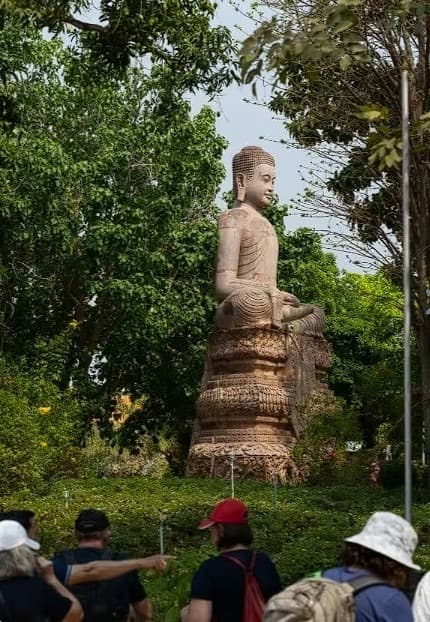
Oudong, the ancient capital of the kingdom
Oudong, the ancient capital of the kingdom
Located 40 km from Phnom Penh, Oudong served as the royal capital of Cambodia for over 250 years. A hilltop of stupas, pagodas and viharas that traces Khmer history.
Approximately 40 km north of Phnom Penh, in Kandal province, Oudong was the royal residence and capital of Cambodia for over 250 years. The site spreads across a double-peaked hill transformed into a royal necropolis, where several sovereigns rest at the foot of stupas, viharas and pagodas erected from the 17th to the 21st century.
Why visit Oudong
Oudong is one of the rare sites near Phnom Penh to concentrate so many layers of Khmer history in a single location: royal tombs, Buddhist temples, a mosque of Cham origin, a memorial to the victims of the Khmer Rouge, and a major contemporary meditation center. The visit thus combines dynastic history, religious architecture and views over the rice paddies and the Tonlé Sap plain. It makes for a half-day excursion from the capital, complementing a stay in Phnom Penh.
History of Oudong
Oudong was founded by King Soriyopor (Barom Reachea IV) in 1601. In the mid-19th century, King Ang Duong (1841-1850) transformed it into a true royal city adorned with canals, terraces, bridges and over a hundred pagodas.
In 1863, King Norodom I and Admiral Doudart de Lagrée signed the treaty placing the Khmer kingdom under French protection, in response to pressures from Siam and Annam. In 1866, the sovereign chose Phnom Penh as the new capital and the court relocated, ending Oudong's political role.
In 1977, the site was ravaged by the Khmer Rouge. On one side of the hill, a memorial now houses the remains of hundreds of victims from that period.
What to see at Oudong
The hill of royal stupas
The largest part of the hill houses several stupas from different periods:
- Chetdei Mouk Pruhm contains the remains of King Monivong, who died in 1941.
- Trai Traing, in the center, is adorned with four faces of Bayon oriented in the four directions of Kandal province. It was built by King Norodom I in 1891 for his father, King Ang Duong.
- Damrei Sam Poan, built in the 17th century for King Soriyopor, is the oldest of the group.
- The largest and most recent, completed in 2002, housed a bone of the Buddha originally kept in a stupa in front of Phnom Penh station. This relic, considered the most sacred in Cambodia, was stolen in 2013.
Preah Arthross Pagoda and viharas
On the other slope stands the Preah Arthross Pagoda, whose great Buddha statue faces north—a rare orientation, since tradition dictates that Buddha should face east. The name means "Temple of the Eighteen Corners" in reference to the 18 cubits of its structure.
A 13th-century legend recounts that a Chinese emperor sent emissaries to identify neighboring powers. At Oudong, they saw a mountain pierced by an opening resembling the form of a naga, the multi-headed serpent of Buddhist mythology. Impressed by Khmer wealth, they reported that a people capable of conjuring a naga could dominate the world. To avoid war, the emperor asked the Khmer sovereign for permission to build a temple at the location of the opening, with the Buddha's face turned toward China to protect his empire.
Behind the pagoda, the Chker Amao stupa bears the name of a great monk's dog, an animal renowned for its intelligence and venerated. Further northeast, along the ridge, three small viharas align: Vihear Preah Ko (the Sacred Cow), Vihear Preah Keo (the Sacred Precious Stone) and Vihear Prak Neak (the Buddha Protected by a Naga), where one can observe a sacred cow statue, golden buddhas and painted frescoes.
Ta Sann Mosque
The small Ta Sann Mosque testifies to religious tolerance during King Ang Duong's reign: the king donated 50 m² of land to Imam Sann, who came from Champa, the ancient Islamic empire that once shared Indochina with the Khmers. According to local tradition, the sovereign maintained regular discussions with this Muslim religious leader on the dharma of their two traditions.
Vipassana Dhura Pagoda
At the foot of the hill, the Vipassana Dhura Pagoda is part of a vast meditation center that welcomes Buddhist monks year-round. Its prayer hall, gilded on the outside, houses a large Buddha statue and wall frescoes. It's an option for visitors who prefer not to climb the hill's staircase.
Practical information
- Duration of visit: allow 2 to 3 hours on site to explore the hill and monastic complex.
- Access to the summit: ascent is via a long stone staircase, demanding in the heat. Bring water, a hat and sturdy shoes.
- Dress code: Oudong remains an active religious site. Shoulders and knees must be covered, and shoes removed before entering pagodas.
- Hours: the site is generally accessible during the day. Pagodas close in late afternoon.
- Admission: free or very modest entry; a donation to the pagodas is appreciated.
When to visit Oudong
The dry season, from November to March, offers the most comfortable conditions: bearable temperatures and clear skies for views from the summit. From April to June, the heat makes climbing the staircase exhausting; it's best to go early in the morning. During the rainy season (June to October), showers mainly fall in late afternoon and the surrounding countryside is lush green. A morning visit is recommended year-round to avoid midday heat.
How to reach Oudong
Oudong can be reached from Phnom Penh, approximately 40 km north via National Road 5. Several options:
- Tuk-tuk: budget option, count about 1.5 hours each way. Negotiate the round-trip price with waiting time on site.
- Taxi or private car with driver: more comfortable, about 1 hour's drive. Recommended solution for a half-day excursion.
- Boat: upstream journey on the Tonlé Sap from Phnom Penh, slower but scenic. See our boat tour from Phnom Penh.
Nearby attractions
- Bayon Temple at Angkor, another major site of Khmer stone faces.
- The Terrace of Elephants, a royal remnant of the Angkor Thom site.
- The Cambodia-Vietnam Friendship Monument, in Phnom Penh itself.
Frequently asked questions
Frequently asked questions
Allow 2 to 3 hours on site, plus approximately 1 to 1.5 hours of travel from Phnom Penh each way. A half-day to a full day is ideal.
The stone staircase is long and exposed to full sun. It remains accessible to anyone in good health, provided you start early and bring water. The Vipassana Dhura Pagoda at the foot of the hill can be visited without climbing.
Shoulders and knees covered, as with all active Buddhist sites in Cambodia. Shoes are removed before entering viharas and pagodas.
In 1866, King Norodom I, shortly after signing the protectorate treaty with France in 1863, decided to transfer the capital to Phnom Penh, better situated at the confluence of rivers for commerce and modern administration.
Yes. Many travelers combine Oudong with Silk Island (Koh Dach) or a return trip by boat on the Tonlé Sap to turn the excursion into a loop.
Plan your stay
Oudong fits easily into a Cambodian itinerary combining Phnom Penh, Angkor and the south of the country. To prepare your itinerary, consult our tailor-made Cambodia trips.
Interested in this visit?
We can include it in your personalised itinerary.