
The Royal Palace of Phnom Penh
The Royal Palace of Phnom Penh
Official residence of Cambodia's sovereigns since 1870, the Royal Palace of Phnom Penh combines the Throne Hall, Chanchhaya Pavilion and Silver Pagoda across 18 hectares.
The official residence of Cambodia's sovereigns, the Royal Palace of Phnom Penh spans 18 hectares along Sothearos Boulevard, between Streets 184 and 240. Built from 1866 onwards, it comprises the Throne Hall, the Chanchhaya Pavilion and the Vat Preah Keo (Silver Pagoda) within a complex enclosed by yellow walls and oriented according to Buddhist principles.
Why visit the Royal Palace
The site condenses over a century of Khmer history and remains the ceremonial heart of the kingdom: it is here that recent coronations took place, including that of King Norodom Sihamoni in 2004. The visit allows you to observe well-preserved traditional Khmer architecture (tiered roofs, gilded prasat), a Silver Pagoda with a floor paved with over 5,000 silver tiles, and exceptional religious artworks, from the crystal Buddha to the solid gold Maitreya Buddha.
The Palace also serves as a powerful geographical landmark: it faces Chaktomouk, the confluence point where the Mekong divides and forms four arms with the Tonlé Sap and Tonlé Bassac. Its central location often makes it the first stop when discovering the capital.
History of the Royal Palace
The Royal Palace was designed by a Khmer architect and constructed with the help of the French protectorate in 1866. It stands on the ruins of a citadel built in 1813 by King Ang Chan II. The site was chosen by a commission of astrologers and royal ministers, due to its position facing the confluence of rivers: water, an essential element, was meant to confer power and stability on the sovereign.
The official inauguration took place on February 14, 1870, and the royal court moved there permanently in 1871. All buildings were oriented eastward, in accordance with the sacred rules of Buddhist construction. The surrounding walls were erected in 1873, then painted in royal yellow.
The complex underwent several phases of transformation: additions, reconstructions and restorations succeeded one another through the reigns. The Silver Pagoda (Vat Preah Keo) dates from 1892-1902 under Norodom I, while the current Throne Hall and Chanchhaya Pavilion were erected from 1913 to 1919 at the request of King Sisowath, replacing the original wooden structures. The Palace was temporarily abandoned during the Khmer Rouge period before recovering its royal function.
What to see on site
The Throne Hall
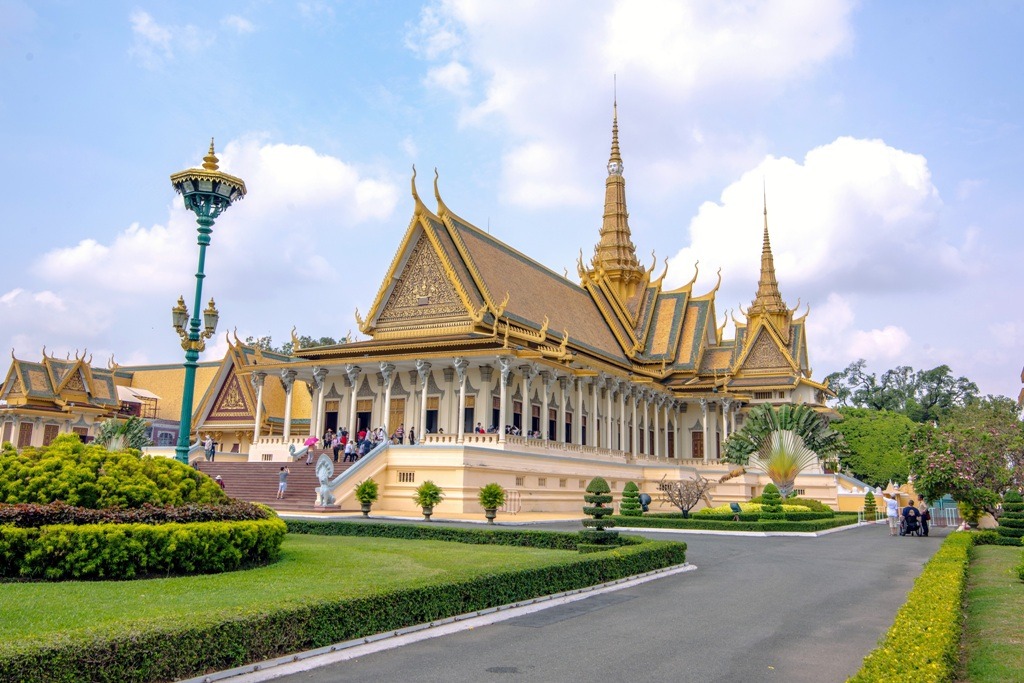
Built in the shape of a cross and topped by three prasat, the Throne Hall continues to host religious and royal ceremonies (coronations, royal weddings) as well as official meetings. The central spire reaches 59 meters and is crowned with a four-faced Brahma head. The interior may be closed to visitors when a ceremony is taking place.
The Chanchhaya Pavilion
Visible from outside the enclosure, the Chanchhaya Pavilion, or Moonlight Pavilion, served as a stage for royal dancers and as a tribune allowing the sovereign to face the crowd. It was used in 2004 for the coronation of King Norodom Sihamoni.
The Vat Preah Keo (Silver Pagoda)
Built from 1892 to 1902 under Norodom I, the pagoda houses several national treasures. The "Emerald Buddha,
Interested in this visit?
We can include it in your personalised itinerary.