Phimeanakas Temple
Phimeanakas Temple
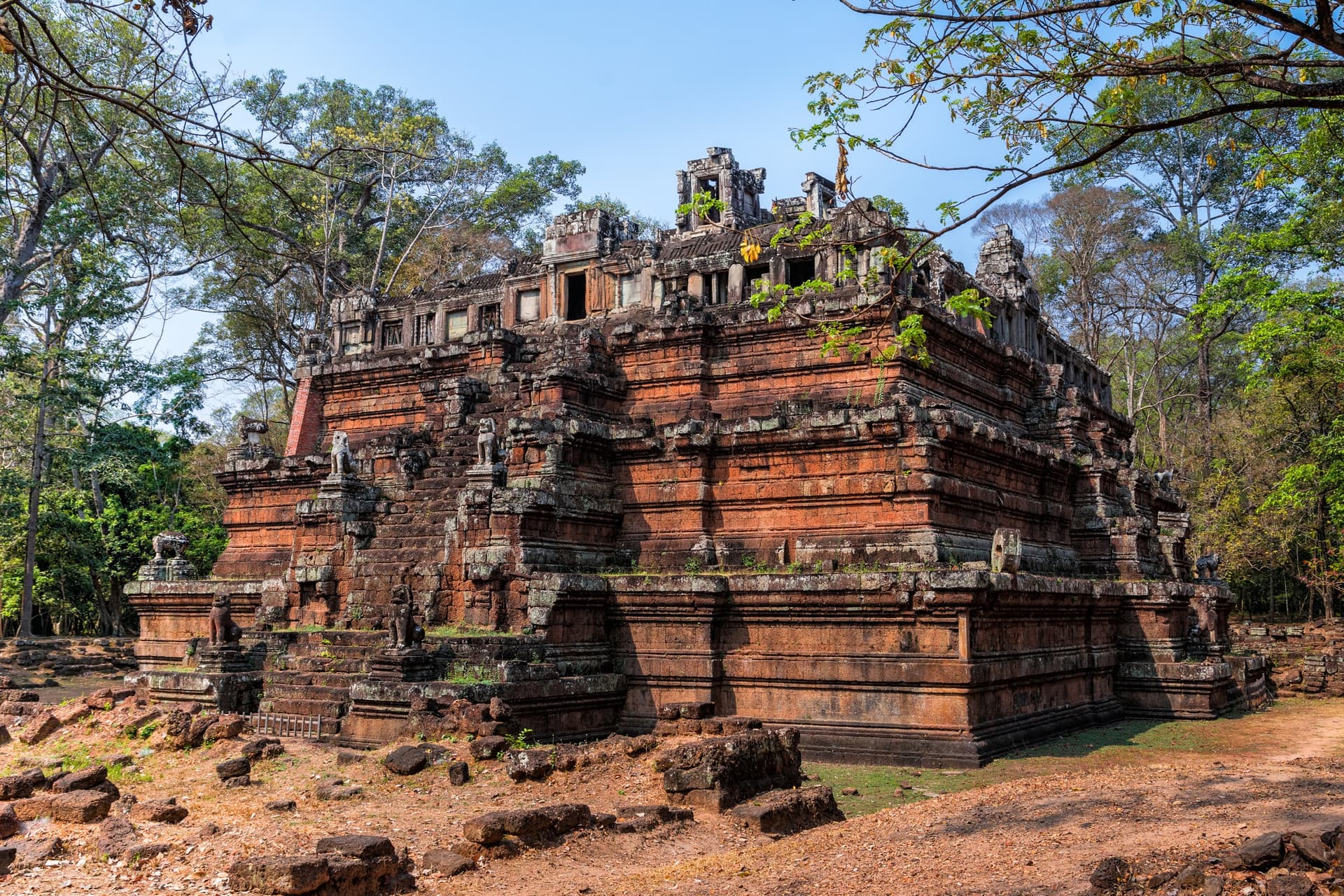
A three-tiered laterite pyramid at the heart of Angkor Thom, Phimeanakas served as a private royal sanctuary and remains connected to the legend of the nine-headed serpent.
Phimeanakas, the celestial palace of Angkor Thom
Phimeanakas, whose name means celestial palace, is a small Hindu temple located within the royal palace enclosure of Angkor Thom, northwest of Baphuon and on the west side of the Terrace of Elephants. A three-tiered laterite pyramid reaching 30 metres high, it long served as a private sanctuary for Khmer sovereigns and remains one of the most legend-laden structures of the ancient city.
Why visit Phimeanakas
Phimeanakas stands apart from the great temples of Angkor by its restraint: minimally carved, built of roughly hewn laterite blocks, it draws its power from its geometric volume and its location at the heart of the royal palace. Three main reasons warrant a stop at the site:
- Its historical function as a private royal sanctuary under Jayavarman VII, a rare testament to personal use of a temple by the Khmer sovereign.
- Its pyramidal architecture in the Khleang style, symbolising Mount Meru, the sacred mountain of Hindu cosmology.
- The legend of the nine-headed serpent, one of the most famous narratives of Angkorian mythology.
The temple naturally integrates into a visit of Angkor Thom, within steps of Baphuon, the Terrace of Elephants and Prah Palilay.
History and legend
Construction of Phimeanakas began in the late 10th century under the reign of Rajendravarman (941-968). It was completed by Suryavarman I and later renovated by Jayavarman VII, who made it his private palace. The temple then served as a personal sanctuary to the king, apart from major public ceremonies.
Local legend tells that a nine-headed serpent (naga) inhabited the golden pavilion crowning the summit. Each night, the naga would transform into a woman and seduce the sovereign: before joining his wives and concubines, the king had to climb to the summit to unite with her. Tradition held that the stability of the kingdom depended on this nightly ritual.
In the late 13th century, the Chinese diplomat Zhou Daguan, on a mission to Angkor, described the temple crowned with a golden spire and nicknamed it the Tower of Gold. This spire has since disappeared, but its memory remains attached to the monument.
Architecture and features to observe
A three-tiered laterite pyramid
Phimeanakas presents itself as a square pyramid with three massive storeys, standing 30 metres high. The lower base measures 35 m long by 28 m wide; the upper platform 30 m by 23 m. The construction belongs to the Khleang architectural style, characteristic of a transitional period in Khmer art. The whole represents Mount Meru, the axis of the world in Hindu cosmogony.
Laterite, a porous stone extracted locally, gives the temple its reddish hue and explains the scarcity of bas-reliefs: this material is poorly suited to fine sculpture, unlike the sandstone used on other Angkor temples.
Entrance, staircases and sculptures
The main entrance, facing east, is marked by a gopura, the characteristic gate-tower of Khmer architecture. On this gate appears an inscription of the oath of allegiance to the king of Angkor, a precious document for historians of the period.
Four extremely steep staircases serve the four faces of the pyramid. They are framed by walls carved with lions and crowned with figures of male and female Garudas. On each level, at the four corners, statues of lions and elephants in sandstone remain, most of them now broken.
The summit sanctuary and the view
At the summit stands a small cruciform sanctuary with four open vestibules. When access to the upper terrace is open, views extend to the neighbouring Bayon temple to the south and Baphuon below.
The royal baths
North of the temple stretch two large pools, traditionally called the women's baths. Their walls are decorated with carvings of crabs, giant lizards, fish and crocodiles, evoking the aquatic world that surrounded the royal palace.
Practical information
- Site access: Phimeanakas is included in the Angkor entrance ticket (Angkor Pass), required to visit all temples in the archaeological park.
- Dress code: shoulders and knees covered, as in all Angkor temples.
- Summit access: climbing the pyramid is generally restricted for conservation reasons. Enquire on-site on the day of your visit.
- Visit duration: allow 30 to 45 minutes to tour the temple and basins.
- Distance from the centre: approximately 11 km from Siem Reap, accessible by car, tuk-tuk or bicycle depending on your pace.
- Access on foot: from Prah Palilay or the Terrace of Elephants, follow the south side of the enclosure wall for about 200 metres then turn left towards the east.
When to visit
The dry season, from November to March, offers the best visiting conditions: clear skies, more tolerable temperatures and passable paths. The light in late afternoon particularly enhances the red laterite of the pyramid.
From June to October, the monsoon makes the surrounding vegetation denser and the stones more contrasted, but showers can complicate travel by bicycle or tuk-tuk. In high season (December-February), plan to visit Phimeanakas early morning to avoid crowds that flock to Bayon and Baphuon.
Nearby attractions
Phimeanakas integrates into the royal palace circuit of Angkor Thom, which can be toured on foot:
- Baphuon, immediately to the south, another temple-pyramid dedicated to Shiva.
- The Terrace of Elephants, an ancient royal tribune 350 metres long.
- Prah Palilay, a small Buddhist sanctuary to the north, in a wooded setting.
- Bayon temple, at the centre of Angkor Thom, famous for its face towers.
Frequently asked questions
Frequently asked questions
Preparing your visit
Phimeanakas is best discovered as part of a broader stay in Angkor, at the heart of a journey through Cambodia. Our English-speaking local team can integrate the temple into an itinerary combining the major sites of the archaeological park and the less-travelled regions of the country.
Interested in this visit?
We can include it in your personalised itinerary.