Nakhon Sawan
Nakhon Sawan
At the confluence of the Ping and Wang rivers, Nakhon Sawan combines Thailand's largest freshwater lake, a thriving Sino-Thai community, and a spectacular lunar new year—far from tourist crowds.
Nakhon Sawan — "City of Paradise" in Sanskrit — spreads across the confluence of the Ping and Wang, two of the four rivers that form the Chao Phraya. A geographical crossroads between northern and central Thailand, the city is known for its impressive Bueng Boraphet lake, the country's largest freshwater body, and for its Chinese New Year celebration among the most vibrant outside Bangkok. It remains largely undiscovered by foreign travelers, lending it an authentic character.
Quick essentials
Access: railway station on the Bangkok–Chiang Mai line; long-distance buses from Mo Chit (Bangkok) and Chiang Mai.
Recommended duration: one full day suffices for the main sites; two days if you wish to explore Bueng Boraphet thoroughly.
Best season: November to February (dry season, pleasant temperatures).
Dress code: covered clothing recommended for temples (shoulders and knees covered).
What to see
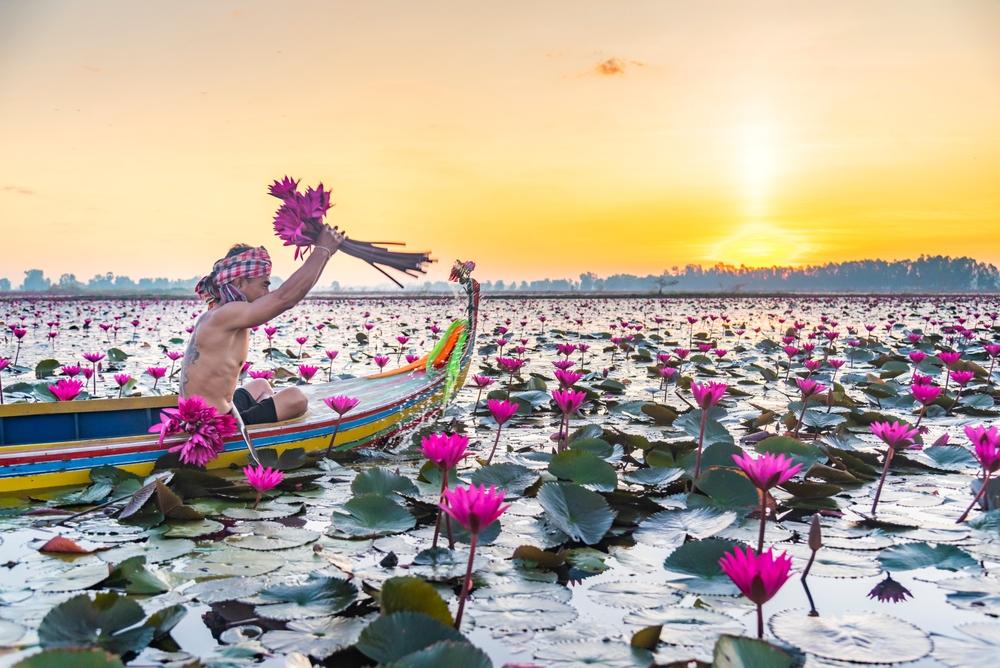
Bueng Boraphet lake dominates the natural agenda: a major bird sanctuary, it welcomes hundreds of migratory bird species between November and February. Boat trips allow you to navigate between reed zones and floating islets. In town, the Sino-Thai quarter concentrates Buddhist temples and Taoist shrines, extraordinarily lively during the lunar new year.
History and context
The city owes its historical importance to its position as a river checkpoint: junks traveling up the Chao Phraya would stop here before branching north. This commercial role attracted a substantial Sino-Thai community as early as the nineteenth century, whose descendants perpetuate traditions and architecture in the historic center. The river confluence remains a site of ceremony during water festivals.
Highlights of a visit
Bueng Boraphet
This lake of roughly 200 km² constitutes Thailand's largest natural freshwater expanse. The adjacent nature reserve protects rare species such as the giant soft-shelled turtle of the Mekong. Early morning boat trips offer the best bird-watching opportunities.
Nakhon Sawan Chinese New Year
Each January or February, the city hosts one of Thailand's most spectacular lunar new year celebrations: dragon parades, fireworks, night markets, and rituals in Taoist temples. The event draws visitors from across the country.
Wat Woranat Bonphot
This Buddhist temple perched on Khao Kop hill offers an unobstructed view of the river confluence and surrounding plains. The white chedi visible from afar serves as a landmark for the entire city.
Confluence of the Ping and Wang
The meeting point of the rivers, locally called Pak Nam Pho, is the city's symbolic cradle. Boat excursions allow you to observe where the waters meet and the banks animated by fishermen.
Etiquette and visit guidelines
Remove your shoes before entering any temple building.
Shoulders and knees covered in sacred areas.
Speak softly inside sanctuaries.
Ask permission before photographing monks or worshippers in prayer.
Photography tips
Bueng Boraphet lake is most photogenic at dawn, when morning mist blurs the horizon and birds are active. For Chinese New Year, position yourself early along the parade route: dragons and lantern bearers pass in late afternoon before dusk. On Khao Kop hill, golden end-of-day light illuminates the chedi and river panorama.
Location and access
Nakhon Sawan lies about 240 km north of Bangkok, midway on the route to Chiang Mai. The railway station is served by trains on the northern line several times daily. Air-conditioned buses connect the city to Bangkok terminals (Mo Chit, Victory Monument) and northern towns. Within the city, songthaews (shared vans) and tuk-tuks handle local travel. Access to Bueng Boraphet lake is via tuk-tuk or motorcycle taxi from the center.
Nearby areas
Kamphaeng Phet — ancient walled city, a UNESCO site approximately 100 km north, with laterite temple ruins set in a forested landscape.
Phichit — quiet riverside town known for traditional long-boat races and ancient temples.
Uthai Thani — peaceful river town to the west, gateway to the Huai Kha Khaeng wildlife sanctuary.
Frequently asked questions
Frequently asked questions
The dry season, from November to February, combines pleasant temperatures with peak migratory bird presence on Bueng Boraphet lake. Chinese New Year (January or February by the lunar calendar) is the year's most animated time.
By train from Hua Lamphong or Bang Sue station on the northern line, or by bus from Mo Chit terminal. The city is also accessible by car via national highway 1 (Phahon Yothin).
Yes: shoulders and knees covered, shoes removed at the entrance to sacred buildings. These rules apply equally in Buddhist temples and Taoist shrines in the Chinese quarter.
The lake is home to resident species year-round, but diversity peaks between November and February, when migrants from Central Asia and China winter at the site.
Yes. The city fits naturally into a Bangkok–Chiang Mai itinerary: an overnight stop allows you to visit the lake and historic center before continuing toward Kamphaeng Phet or Phitsanulok.
Generally yes for exteriors and statues. Inside prayer halls, check on-site signage and ask permission before photographing people in devotion.
Also discover
Want to discover this destination?
Our local advisors design your tailor-made trip.