Banteay Samre
Banteay Samre
A 12th-century Hindu temple located 18 km from Siem Reap, Banteay Samré captivates with its sculpted pediments and architecture akin to Angkor Wat.
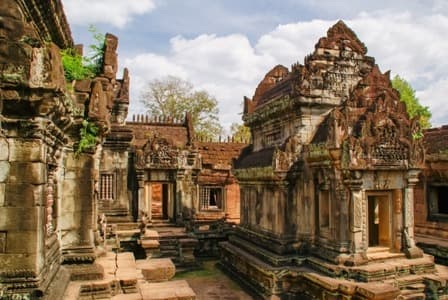
Banteay Samré, whose name means "the citadel of the Samrés," lies approximately 500 metres east of the Eastern Baray, 18 km from Siem Reap. This Hindu temple within the Angkorian complex derives its name from an ancient Indochinese ethnic tribe that inhabited the region between Tonlé Sap Lake and Phnom Kulen. Less frequented than major sanctuaries, it offers a detailed reading of 12th-century classical Khmer architecture.
Why Visit Banteay Samré
The site presents three main points of interest for those drawn to Angkorian art:
- A clear stylistic affinity with Angkor Wat, with which it shares architectural vocabulary and the same chronological horizon.
- Remarkable preservation of sculpted pediments and lintels, legible in the detailed scenes of the Ramayana.
- Moderate visitor numbers compared to temples on the main circuit, allowing for a leisurely exploration of the enclosures and causeways.
The temple appeals equally to enthusiasts of Hindu iconography and travellers seeking to deepen their understanding of Angkor beyond the most popular sites.
History of the Temple
Construction of Banteay Samré began in the 12th century under the reign of Suryavarman II, the sovereign who commissioned Angkor Wat, and was completed under Yasovarman II. The sanctuary is dedicated to Vishnu, one of the major deities of Hinduism.
Its name refers to the Samrés, a mountain people who occupied the area between Tonlé Sap Lake and the Phnom Kulen massif. This toponymic connection distinguishes the temple from other Angkorian structures whose names are of later or descriptive origin.
The site was rediscovered as a heap of stones in 1930. Between 1936 and 1944, Maurice Glaize, a member of the French School of the Far East (EFEO), oversaw its reconstruction using the anastylosis method: reassembly of original elements while replacing the minimum of missing pieces. This campaign made Banteay Samré one of the best-restored temples in the complex.
What to See On Site
The Sanctuary Layout
The temple is inscribed within a fortified enclosure formed by two large concentric walls standing 6 metres high. The two inner enclosures cover 6,000 m² and 1,800 m² respectively. They house a central temple, four gopuras (monumental gateways), a hall and two libraries.
The Central Tower and Mandapa
The sanctuary tower rises to over 20 metres. It comprises several articulated volumes, including the antarala (vestibule) and the mandapa, a cross-shaped hall measuring 2.50 m wide by 7 m long. Built in sandstone and pierced with two side doors, the mandapa was used in a later period as a tomb, an unusual function for this type of structure.
Causeway, Terrace and Sculptures
A laterite-paved causeway 200 metres long leads to the main tower. It is bordered by a balustrade adorned with nāgas (mythical serpents) standing 0.95 m high. The moats flanking the avenue are not always filled with water, depending on the season.
The avenue opens onto a cruciform terrace measuring 23 m wide by 25 m long, raised approximately one metre above ground. The central stairway leading up is flanked by sculpted seated lions.
The pediments and lintels constitute the site's principal interest: they unfold scenes from the Ramayana and other mythological episodes featuring Vishnu, Garuda, Krishna, Indra, Rāma and Rāvana. The narrative density and fineness of execution recall those of Angkor Wat.
Practical Information
- Access: included in the Angkor Pass purchased at the park entrance.
- Hours: open daily during daylight hours. Entry is available from early morning until late afternoon, like the entire archaeological park.
- Duration of visit: allow 45 minutes to 1 hour on site to tour both enclosures and observe the sculptures.
- Best time: late afternoon light brings out the west-facing pediments. The dry season (November to March) remains most comfortable.
- Dress code: shoulders and knees covered, as in all temples in the park.
How to Get There from Siem Reap
Banteay Samré is located 18 km from Siem Reap town centre, away from the Small and Grand circuits. Several options:
- Tuk-tuk: the most common means. Allow 30 to 45 minutes travel time depending on traffic. The temple is often combined in one day with Banteay Srei, situated further north.
- Car with driver: a comfortable option for a combined day of Banteay Samré + Banteay Srei + Pre Rup.
- Bicycle: feasible for experienced cyclists (18 km flat route), but best avoided during the hottest hours.
Nearby Attractions
- Angkor Wat: the benchmark 12th-century temple, whose style Banteay Samré shares.
- Angkor Thom: the fortified royal city and its state temple, the Bayon.
- Bakong: an older temple-mountain from the Roluos group, useful for grasping the evolution of Khmer architecture.
Frequently Asked Questions
Frequently asked questions
Plan Your Visit
Banteay Samré fits naturally into a multi-day Angkorian itinerary, which allows alternating between major sites and quieter temples. To build a coherent stay around Siem Reap and beyond, consult our custom Cambodge journeys.
Interested in this visit?
We can include it in your personalised itinerary.