Bakong
Bakong
The first sandstone temple-mountain built by the Khmer empire, constructed in 881 under Indravarman I, Bakong is the centerpiece of the Roluos group, 15 km from Siem Reap.
Bakong is the first sandstone temple-mountain built by the Khmer empire. Constructed in 881 under King Indravarman I, it stands today as the centerpiece of the Roluos group, 15 km east of Siem Reap. Dedicated to Shiva, this state temple foreshadows the architecture that would reach its pinnacle later at Angkor Wat.
Why Visit Bakong
Bakong holds a singular place in the history of Khmer architecture: it is the first temple-mountain built entirely in sandstone, a model that would inspire the major sanctuaries of Angkor for three centuries. The five-tiered pyramid, the sculpted lintels of the peripheral prasats, and the monumental staging of Mount Meru make it an essential stop for understanding the genesis of Angkor style. The site, quieter than temples in the main park, allows for a leisurely visit.
History
Bakong was constructed in 881 by King Indravarman I and dedicated solely to the god Shiva. The temple then served as a state sanctuary at the heart of Hariharalaya, a royal capital founded a few decades earlier. Under the reign of Jayavarman II, Angkor's first king, Hariharalaya was a capital of this empire before the center of power shifted northward to what would become Angkor. Hariharalaya is today known as Roluos.
As the first sandstone temple-mountain of the Khmer empire, Bakong inaugurates a foundational architectural type: the stepped pyramid representing Mount Meru, the cosmic mountain of Hindu mythology. Severely damaged over the centuries, the central pyramid was reconstructed between 1936 and 1943 by Maurice Glaize, a member of the French School of the Far East (EFEO), using the anastylosis method.
What to See on the Site
The sacred precinct extends over a perimeter of 3 km, surrounded by two moats and three enclosure walls. Four gopuras, porches crowned with towers, mark the cardinal access to the temple. Inside, the visitor progresses toward the central pyramid while passing several secondary structures.
The Central Pyramid
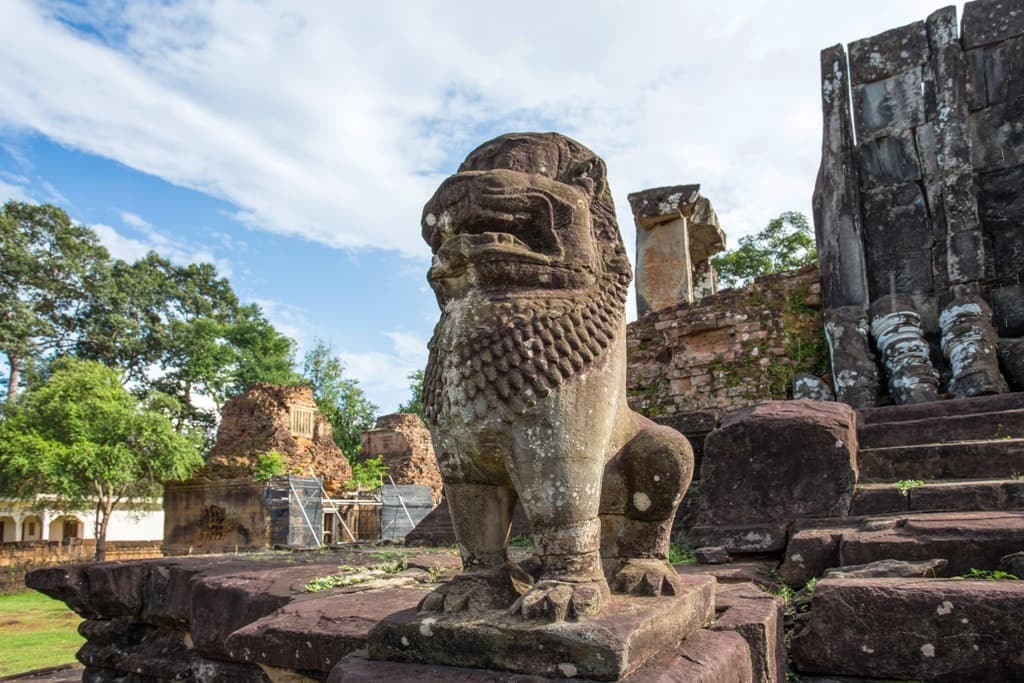
The heart of the sanctuary, the pyramid rests on a square foundation 65 to 67 m on each side and rises as a five-tiered pyramid. Four axial staircases lead to the summit. Guardian lion statues on the staircases punctuate the ascent, while stone elephant statues at the corners of the tower occupy the angles of the lower terraces.
At the top stands a central sanctuary, a four-story square tower with a lotus-shaped upper section. Here, in this cell facing east, resided Shiva's lingam. Around the upper platform stand 12 small towers, some collapsed. The ensemble forms a symbolic representation of Mount Meru.
The Peripheral Prasats and Their Lintels
At the base of the pyramid are arranged eight prasats around the pyramid's base, built in brick with lintels sculpted in sandstone. These modest yet finely decorated secondary towers deserve attention for their lintels: they feature sculptures representing Garuda, Raksasas, Naga, and Yaksha, figures from the Hindu pantheon. Several of these lintels are among the oldest surviving in situ in Khmer art.
Practical Information
- Access: part of the Roluos group, accessible with the Angkor pass (1 day, 3 days, or 7 days).
- Duration of visit: allow 45 minutes to 1.5 hours depending on your interest in sculpted details.
- Hours: open from sunrise to sunset, like all temples in the archaeological park.
- Dress code: shoulders and knees covered to access sacred areas; flat shoes recommended for climbing the pyramid.
- Water: bring a bottle; there is little shade on the pyramid.
When to Visit
The dry season, from November to March, offers the most comfortable conditions: bearable temperatures, clear skies, and passable ground. From April to May, temperatures often exceed 95°F (35°C) and make climbing the pyramid challenging. The rainy season (June to October) greens the temple surroundings but may interrupt visits with brief, intense showers. Early morning (before 9 am) or late afternoon light brings out the sculptures and keeps visitor numbers low, as Bakong sees fewer crowds than Angkor's central temples.
How to Get There
Bakong is located 15 km east of Siem Reap, accessible via National Road No. 6. Tuk-tuks and taxis are the most practical options from the city: expect about 30 to 40 minutes of travel. Most visitors combine Bakong with the other two temples in the Roluos group (Preah Ko and Lolei) in a half-day circuit. Renting a bicycle is also possible for independent travelers, as the road is flat.
Nearby
The Roluos group comprises three temples worth visiting together: Bakong, Preah Ko (to the north), and Lolei (further north). To extend your exploration of Khmer sanctuaries around Siem Reap:
- Banteay Srey, the "temple of women" renowned for its pink sandstone sculptures.
- Banteay Samre, a well-preserved 12th-century temple.
- Banteay Kdei, a Buddhist monastery in peaceful surroundings.
Frequently Asked Questions
Frequently asked questions
Yes. Bakong belongs to the Roluos group, integrated into the Angkor archaeological park. The Angkor pass (1, 3, or 7 days) covers access to all three temples in the group: Bakong, Preah Ko, and Lolei.
Allow 45 minutes to 1.5 hours on site. To visit all three temples in the Roluos group, plan for a half-day.
Yes, climbing is permitted via the axial staircases. The steps are steep and uneven: exercise caution on the descent, particularly in damp conditions.
Bakong predates Angkor Wat by more than two centuries and represents the prototype of the Khmer temple-mountain. To understand the architectural evolution of Angkor style, visiting Bakong is complementary and instructive.
Far less than the central park temples. Bakong remains relatively quiet, especially early morning and late afternoon.
Organize Your Visit
To include Bakong and the Roluos group in a broader itinerary around Khmer temples, consult our custom trips to Cambodge.
Interested in this visit?
We can include it in your personalised itinerary.