Banteay Srey
Banteay Srey
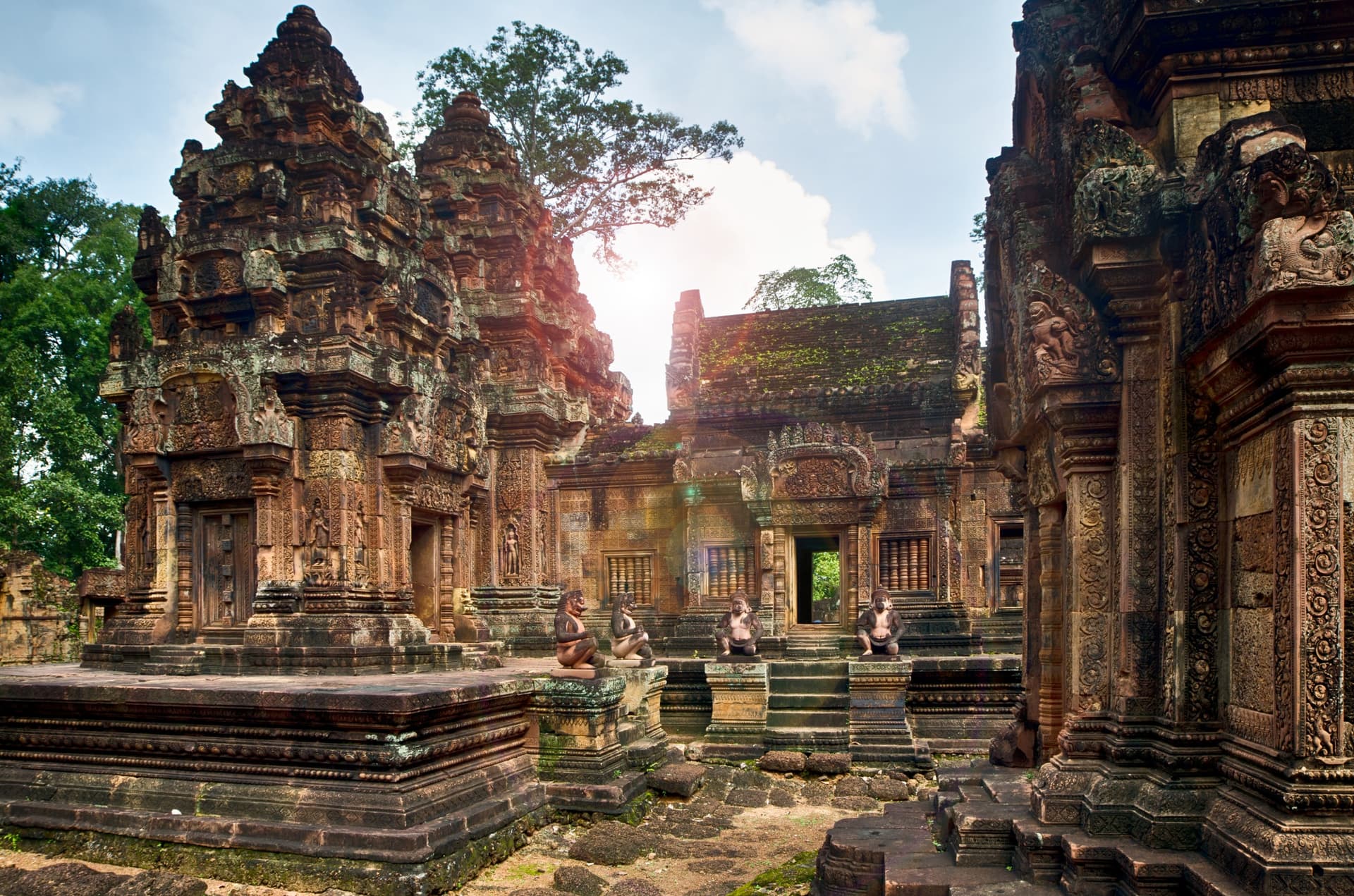
A Hindu temple in pink sandstone located 32 km from Siem Reap, Banteay Srey is renowned for the exceptional finesse of its 10th-century Khmer sculptures.
Banteay Srey, whose name means "citadel of women" or "citadel of fortune", is a Hindu temple within the Angkor complex, situated in the ancient city of Isvarapura, at the foot of Phnom Dei mountain. Built in finely carved pink sandstone, it stands apart from other Khmer temples by its modest size and the exceptional precision of its bas-reliefs. The site is listed as a UNESCO World Heritage site together with the entire Angkor complex.
Why visit Banteay Srey
The temple offers three assets that clearly set it apart from other Angkorean sanctuaries:
- Sculptural finesse without equal at Angkor: lintels, pediments and small columns display floral and mythological motifs of a precision akin to fine jewellery.
- Pink sandstone, a material rarely used elsewhere, which takes on warm tones at dawn and dusk.
- Remarkable preservation, the result of a century of scientific work and the first application of anastylosis technique in Cambodia.
History
Banteay Srey was consecrated in 967, during the reign of Jayavarman V, and dedicated to the deity Shiva under the name Tribhuvanamahesvara, the "Lord of the Three Worlds". Unlike most Angkorian temples, it is not a royal foundation but the work of a Brahmin close to the court, which partly explains its reduced scale.
The site was cleared in 1924 by the French School of the Far East (EFEO). From 1931, archaeologist Henri Marchal directed the first reconstruction of a Khmer temple using the anastylosis method, which involves reassembling original elements while adding the minimum necessary complements. Banteay Srey thus became a benchmark case for the restoration of all Angkor temples.
A second campaign, conducted between 2010 and 2016 by the University of Geneva and the Swiss Federal Institute of Technology Lausanne, repaired damage caused by water runoff, looting and vandalism. The project was financed by the Swiss Agency for Development and Cooperation (SDC) and the Cambodian government.
What to see on site
The sanctuary covers approximately 45,000 m² and is organized into three successive enclosures, enclosed by brick and laterite walls and surrounded by moats. The entrance gates, called gopuras, are arranged mainly on the east and west axes.
Architecture
The second enclosure measures 38 m × 42 m and houses two gopuras with richly decorated pediments. The third, more complex, comprises pillared porches, a cruciform central hall and two passage vestibules serving as galleries or libraries. The whole is built in pink sandstone and laterite.
Sculpture
This is where Banteay Srey truly reveals its dimension. You will observe:
- A statue of the dancing god Siva Nataraja.
- Devatas and dvarapalas (guardians), sculpted in niches.
- Apsaras, celestial nymphs adorning the columns.
- Lintels and pediments illustrating scenes from Hindu mythology centred on Shiva.
The floral motifs covering smooth surfaces are crafted with a density and finesse rarely observed on other Khmer temples.
Practical information
- Angkor Pass: the entry ticket to the Angkor site (1, 3 or 7 days) is valid for Banteay Srey.
- Duration of visit: allow approximately 1 hour on site, longer if you take time to examine the sculptures.
- Opening hours: daily opening from sunrise to late afternoon; check current local opening times.
- On site: a small interpretation centre at the entrance presents the history of restorations.
When to go
The dry season, from November to March, offers the most comfortable conditions for a visit. The colour of the pink sandstone is particularly enhanced at early morning and late afternoon, when the light is low and raking. Conversely, visiting at midday flattens the reliefs and the heat can be exhausting.
Being more remote than Angkor Wat, the site attracts less continuous flows: early in the morning (before tour buses arrive from Siem Reap) or late in the day, you will benefit from reduced crowds.
How to get there
Banteay Srey is located approximately 32 km north-east of Siem Reap, about 45 minutes by road. Several options are available:
- Car with driver: the most comfortable solution, often combined with other temples on the "grand circuit".
- Tuk-tuk: possible but lengthy due to distance; allow a full day.
- Bicycle: feasible for experienced cyclists in the dry season.
Nearby
Banteay Srey fits easily into a day-long visit including other temples in the Angkor complex:
- Angkor Wat, the largest religious monumental ensemble in the world.
- Angkor Thom and its central temple, the Bayon, famous for its face towers.
- Bakong, in the Roluos group, one of the earliest Khmer temple-mountains.
- Banteay Chhmar, a more remote temple to the north-west, for those wishing to extend their discovery of Khmer art.
Frequently asked questions
Frequently asked questions
Organize your visit
Banteay Srey fits into most itineraries for travel to Cambodia including Angkor. Our advisors can integrate this temple into a tailor-made trip, combining it with other Khmer sites according to your duration and interests.
Interested in this visit?
We can include it in your personalised itinerary.