Banteay Chhmar
Banteay Chhmar
A vast temple-city built under Jayavarman VII, Banteay Chhmar preserves bas-reliefs comparable to Bayon and a 128-hectare baray, well away from standard tourist circuits.
Banteay Chhmar ranks among the major monumental complexes of the Angkorian period, yet remains largely outside conventional tourist routes. Located in Banteay Meanchey province, roughly 20 km from the Thai border and 100 km north of Battambang, the site combines a principal temple, eight satellite sanctuaries, and a 128-hectare water reservoir known as a baray in Khmer. Its geographic remoteness, secondary roads, and scarcity of visitors make it a different kind of archaeological exploration from Angkor.
Why visit Banteay Chhmar
The site stands out through three defining features. First, its scale: the principal temple and its enclosure form one of the most expansive complexes built under Jayavarman VII, following the stylistic lineage of Bayon. Second, the quality of its bas-reliefs, some panels of which rank among the finest examples of ancient Khmer art. Finally, visitor flow: unlike Angkor, you will encounter few people here, which fundamentally transforms the experience.
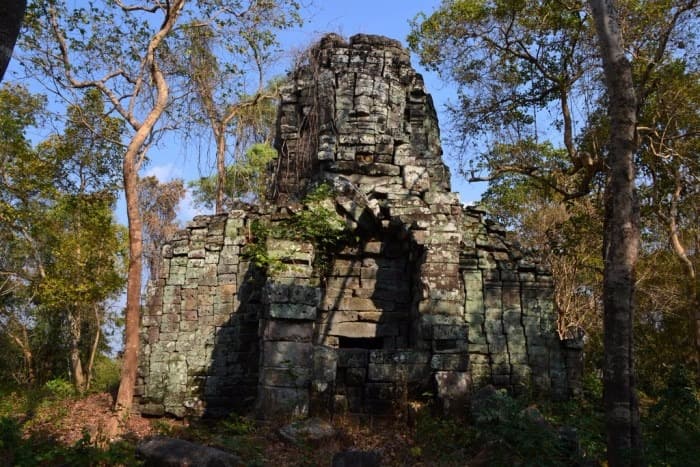
One caveat worth noting: portions of the temple have collapsed and remain unrestored. You walk amid overturned sandstone blocks, requiring careful footing but offering a raw glimpse of archaeology in progress.
History of the site
Banteay Chhmar was constructed in the late 12th century under King Jayavarman VII, during the same architectural phase that produced Bayon and Ta Prohm at Angkor. One sanctuary honors the heir-apparent of Jayavarman VII, who died before his father. Another is dedicated to Prince Srindrakumara and four officers who fell defending King Yasovarman II; four statues representing them are housed in the temple's central hall.
The gates and certain bas-reliefs depict conflicts with Champa, a rival kingdom occupying present-day central Vietnam. The carved scenes document battles, daily life, and the religious pantheon of the era, in a style very close to that of Bayon.
The site suffered significant looting in the 20th century, including the organized theft of extensive bas-relief sections in the late 1990s. Restoration programs coordinated with international teams began in 2007 and continue in phases, with progressive anastylosis work on collapsed walls.
What to see on site
The principal temple and its bas-reliefs
The bas-reliefs of the enclosure wall are the visit's highlight. They closely resemble those of Bayon and depict battles, processions, and daily life scenes. For lighting, the eastern enclosure wall is illuminated in the morning; the western wall receives light from noon onward. Plan your route accordingly: begin on the east side arriving early, then move to the interior sanctuaries before returning to the western side.
The satellite sanctuaries
Eight auxiliary temples dot the site around the principal temple. Several are in advanced ruin and overgrown with vegetation, echoing the state of Angkor before its first clearance campaigns.
The baray and its island temple
The 128-hectare reservoir, now dry, houses at its center an island temple called Mebon in Khmer. This type of hydraulic infrastructure, typical of Khmer urbanism, illustrates the water management expertise underlying the empire's agricultural economy.
Statues and Buddhist iconography
The site preserves numerous Buddha representations. Some were defaced during the iconoclastic episodes of the post-Jayavarman VII period, but a significant portion remains legible.
Practical information
- Visit duration: plan a minimum half-day to tour the main enclosure and accessible sanctuaries. A full day allows you to include the baray and distant satellite temples.
- Ticketing: an entrance fee is collected upon arrival at a moderate rate, with receipts partially supporting site conservation.
- Season: the dry season, November through March, is most comfortable. During monsoon, access tracks may become difficult.
- Equipment: bring closed-toe shoes (uneven terrain, collapsed blocks), water, sun protection, and a flashlight for dark interior areas.
- Accommodation: a homestay program exists in the neighboring village and enables extending your experience to two days.
How to get there
Access to Banteay Chhmar is not straightforward, explaining its low visitor numbers. Three main options are available:
- From Sisophon (Banteay Meanchey): the nearest base. Allow roughly 1.5 hours by private taxi or shared minivan on paved road then track.
- From Siem Reap: expect 3 to 4 hours via Sisophon. Travel typically occurs by private car with driver.
- From Battambang: approximately 3 hours north, also by private vehicle.
No direct public transport runs from Siem Reap. Hiring a vehicle with driver remains the most practical solution and permits combining the visit with other stops in northwestern Cambodge.
Nearby attractions
If you extend your discovery of Khmer heritage, several other temples merit a visit:
- Banteay Srey, celebrated for its refined carvings in pink sandstone, reachable from Siem Reap.
- Banteay Samre, a well-preserved temple within the Angkor complex.
- Banteay Kdei, a Buddhist monastery also built under Jayavarman VII.
- Bakong, a temple-mountain of the Roluos group, one of the oldest major Khmer sanctuaries.
Frequently asked questions
Frequently asked questions
Yes, provided you accept a partially collapsed site and a long journey. The bas-reliefs rival those of Bayon in quality, and the absence of crowds offers a radically different experience.
A half-day for the essentials, a full day to include all eight satellite sanctuaries and the baray.
It's possible but lengthy: 6 to 8 hours of driving round-trip. An overnight stay, in homestay accommodation at Sisophon or the village, is recommended.
Yes, the area has been demined and main paths are cleared. However, stay on marked trails and watch for unstable blocks.
The eastern enclosure wall is lit in the morning, the western wall from noon onward. Arriving early morning allows you to cover both orientations in a single visit.
Planning your trip
Banteay Chhmar naturally fits into an extended itinerary combining Angkor, Battambang, and northwestern Cambodge. To construct a coherent stay integrating this demanding yet striking site, consult our Cambodge travel suggestions.
Interested in this visit?
We can include it in your personalised itinerary.