Baphûon
Baphûon
An 11th-century temple-mountain in the heart of Angkor Thom, Baphûon blends Khmer architecture, Hindu bas-reliefs and a monumental recumbent Buddha on its western face.
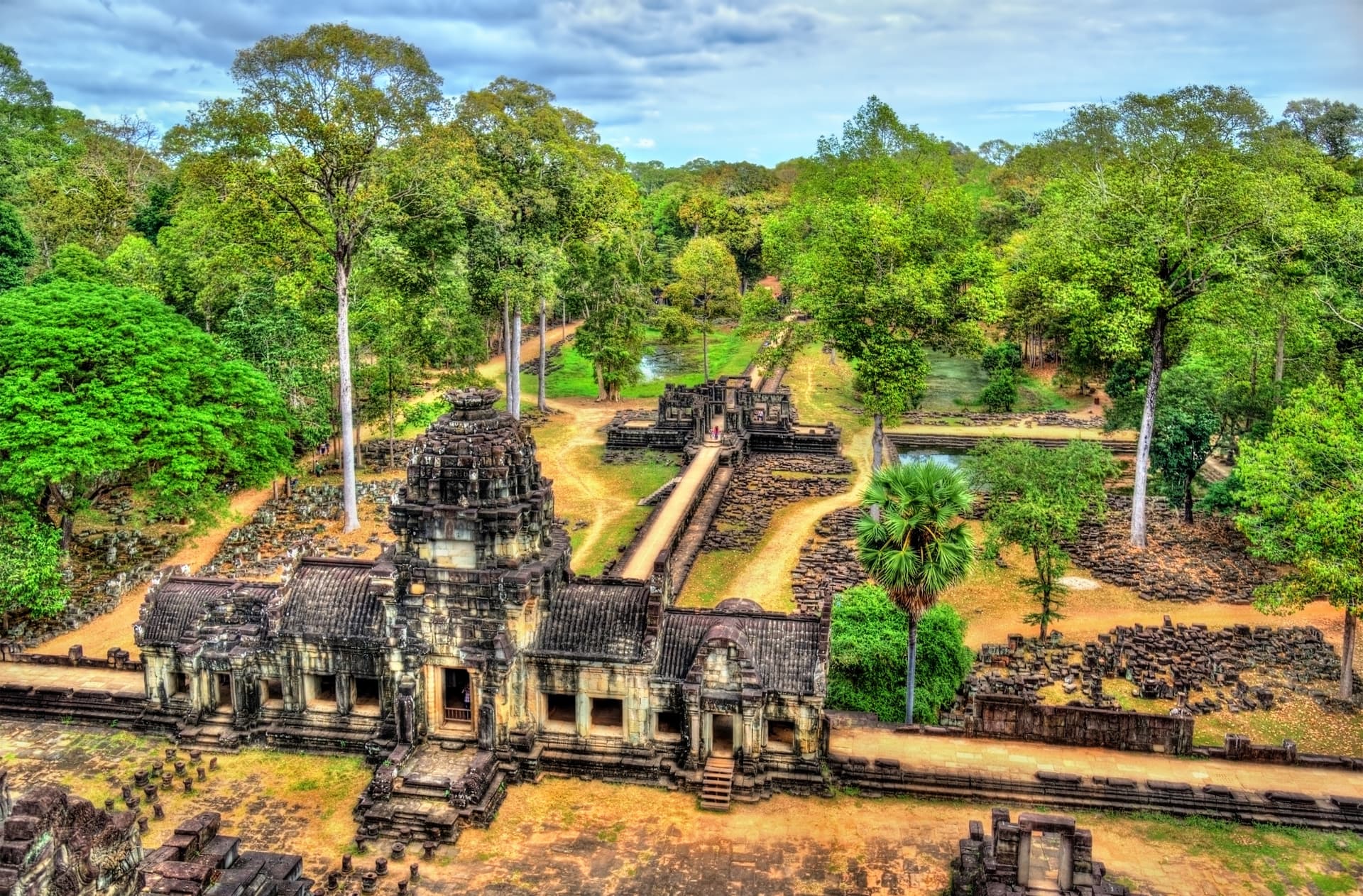
Baphûon is one of the great Hindu temple-mountains of Angkor Thom. Dedicated to Shiva and built in 1060 under the reign of Udayadityavarman II, it served as the state temple of the Khmer capital, nicknamed in its heyday the "Golden Mountain". Its pyramidal silhouette, long colonnade gallery and the 70 m recumbent Buddha integrated into its western face make it a major stop on the Angkor archaeological route.
Why visit Baphûon
Baphûon offers a concentrated perspective on Khmer religious evolution: a Shivaite temple-mountain in the 11th century, partially converted into a Buddhist sanctuary in the late 15th century. It is also one of the longest restoration projects in the history of archaeology: dismantled stone by stone by the French School of Far Eastern Studies in the 20th century, it was not reassembled until 2011, after more than a century of interruptions due to wars and the Khmer Rouge. Its suspended gallery, narrative bas-reliefs and monumental recumbent Buddha warrant a full visit, complementary to Angkor Wat and the Bayon.
History of the temple
Baphûon was built in 1060 under Udayadityavarman II (1050–1066), sovereign of the Khmer empire. Dedicated to Shiva, it symbolizes Mount Meru, the cosmic axis of Hinduism, and served as the state temple. Chinese chronicles report that at its height it was covered in golden elements, hence its nickname the "Golden Mountain".
In the late 15th century, Theravada Buddhism became the dominant religion in Cambodia. Baphûon was then partially dismantled: stones from the western façade were repurposed to build a monumental recumbent Buddha, integrated into the pyramidal structure itself.
The temple was cleared between 1908 and 1918 by the French School of Far Eastern Studies (EFEO) under the direction of Jean Commaille, succeeded by Henri Marchal. Its unstable base, filled with sand, earned it the nickname "sand castle". The EFEO applied the anastylosis method: numbering and dismantling of stones for faithful reconstruction. An initial restoration campaign was conducted in 1960 by Bernard Philippe Groslier (EFEO). Civil war and the Khmer Rouge takeover interrupted the project, and reassembly plans were partly lost. Work resumed in 1995 and concluded in April 2011, after a veritable archaeological puzzle of over 300,000 blocks.
What to see
The pyramidal architecture
Baphûon rests on a base of 13,520 m² surrounded by a rectangular enclosure wall of approximately 8,700 m perimeter. Its three-level pyramid rises to about 35 m, structured by three successive enclosures, gopuras (monumental gates), galleries and a central sanctuary. The whole embodies Hindu cosmology, where the pyramid represents Mount Meru surrounded by its oceans.
The gallery and main gopura
The main gopura faces south, aligned with the east and the Terrace of Elephants. It rests on a cross-shaped pavilion measuring 172 m supported by hundreds of pillars. From there extends a 200 m elevated sandstone gallery leading to the sanctuary. Midway, a basin and pavilion decorated with scenes of animals, hunters and warriors punctuate the approach.
The bas-reliefs
The façades are carved with narrative bas-reliefs drawn from major Indian epics, the Ramayana and the Mahabharata. Floral motifs, combat scenes and figures of Devata complete this iconographic repertoire, characteristic of the Khmer 11th century.
The recumbent Buddha
At the western end, a 9 m high and 70 m long recumbent Buddha is inscribed in the very masonry of the temple. Built in the late 15th century from stones not reused during the Buddhist conversion, its proportions become clearer as one steps back.
Practical information
- Access: included in the Angkor pass (1, 3 or 7 days), shared across all temples in the archaeological park.
- Visit duration: allow 45 minutes to 1.5 hours depending on your interest in the bas-reliefs and the climb to the sanctuary.
- Dress code: shoulders and knees covered, as for all active temples in Angkor.
- Climbing: steep stairways leading to upper levels, not recommended for those with mobility restrictions.
When to go
The dry season, from November to March, offers the most comfortable visiting conditions: manageable temperatures, clear skies and well-exposed stone. From April to June, midday heat can become challenging. The rainy season (July–October) remains feasible, with showers mainly in late afternoon and more contrasted light for photography.
Baphûon is less crowded than the Bayon or Angkor Wat. Visiting early morning, just after the park opens, or in late afternoon allows you to avoid groups and enjoy raking light on the bas-reliefs.
How to get there
Baphûon lies within the Angkor Thom enclosure, approximately 200 m northwest of the Bayon and in immediate proximity to the former Royal Palace. From Siem Reap, allow about ten kilometers to reach the south gate of Angkor Thom. Classic options include a day-long tuk-tuk, bicycle (flat and shaded route), car with driver or a guided tour. Once in Angkor Thom, the temple is reached on foot from the Terrace of Elephants or Bayon parking area.
Nearby
- Angkor Thom — the fortified royal city that encompasses Baphûon, with its monumental gates and moats.
- The Bayon, 200 m away, famous for its face towers.
- The Terrace of Elephants and the Terrace of the Leper King, aligned facing Baphûon.
- Angkor Wat, a few kilometers to the south, the site's largest temple.
- Banteay Kdei and Bakong to further explore Khmer temples.
Frequently asked questions
Frequently asked questions
Include Baphûon in your trip
Baphûon fits naturally into a circuit around the Angkor temples, complementing the Bayon, Angkor Wat and peripheral sites. To plan your itinerary and benefit from local expertise, consult our bespoke Cambodge trips.
Interested in this visit?
We can include it in your personalised itinerary.