Sala Keoku Park
Sala Keoku Park
VQPJ+RH7, Wat That, Mueang Nong Khai District, Nong Khai 43000, Thaïlande
Located 5 km from Nong Khai, Sala Keoku park brings together hundreds of Buddhist and Hindu sculptures designed by exiled artist Bunleua Sulilat.
The Sala Keoku park, a few kilometres from Nong Khai, brings together hundreds of monumental concrete sculptures inspired by Buddhist and Hindu mythologies. Designed by Laotian artist Luang Pu Bunleua Sulilat, this open-air religious garden stands as one of the most singular works of Isan, in north-east Thailand, near the border with Laos.
Why visit Sala Keoku Park
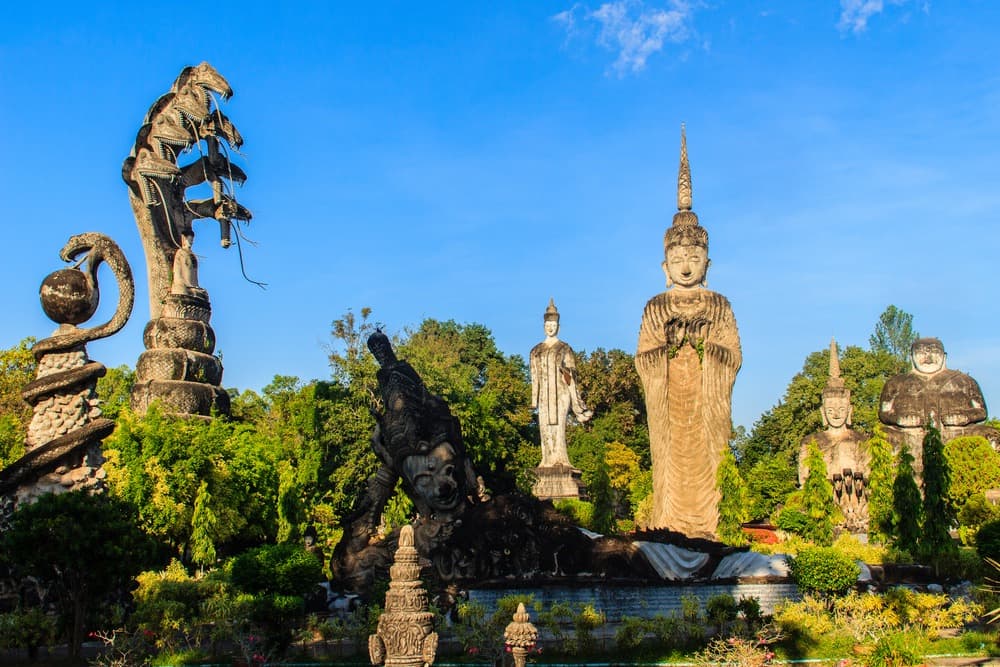
Sala Keoku is unlike any other religious site in Thailand. Where traditional temples follow strict architectural codes, this park deploys a free and outsized iconography, the fruit of a single man's personal vision. The statues blend Hindu deities, Buddhist figures, mythological creatures and moral allegories, sometimes in compositions several metres high.
The site will appeal both to travellers curious about religious art and those who stray from classical tourist circuits. It forms part of an Isan discovery journey—a region still little frequented by international tourism—and complements a stop in Nong Khai, a frontier town on the banks of the Mekong.
The history of the park and its creator
The park is the work of Luang Pu Bunleua Sulilat, a sculptor of Laotian origin. According to accounts shared at the site, his spiritual calling dates back to his youth: he is said to have chanced upon an ascetic named Keoku in a cave, who became his spiritual guide and passed on his passion for religious works.
In his early thirties, Bunleua Sulilat created his first sculpture garden in Vientiane, the Buddha Park (also called Xieng Khuan). In 1975, the communist revolution in Laos forced him into exile: he crossed the Mekong and settled in Thailand. In 1978, he acquired land in Nong Khai and began constructing a second park, which he named Sala Keoku in honour of the hermit from his youth.
Construction would last roughly twenty years. Without a patron, the artist relied on the generosity of local people to gather cement and materials. The sculptures were created by non-professional volunteers, passionate amateurs, which makes the scope and coherence of the whole all the more remarkable.
What you see in the park
The park brings together several hundred concrete statues, arranged without a prescribed route. A few pieces stand out for their size or symbolic weight:
The great statue of Buddha protected by Mucalinda, a seven-headed naga whose coils wrap around the body of the meditant to shelter it from storms. This is the most photographed piece on the site, noted as one of the tallest in the park.
The wheel of life, an illustration of the stages of existence according to Theravada Buddhism, from birth to spiritual rebirth.
The elephant surrounded by anthropomorphic dogs, a moral allegory teaching not to heed gossip.
Hindu deities: Vishnu, Shiva, Durga with multiple arms, as well as scenes inspired by the Ramayana.
Polycephalous nagas, guardians of waters and elements, present in various forms throughout the park.
At the western end, a three-storey white building, the Sala, houses a sanctuary dedicated to Bunleua Sulilat himself, where his embalmed body is displayed, accompanied by photographs chronicling his life and numerous smaller statues.
The descriptions placed at the foot of the sculptures are in Thai only. To grasp the symbolism of each scene, it is helpful to come with an English-speaking guide, or to obtain an explanatory booklet on site.
Practical information
The park is open daily during daylight hours, from morning to late afternoon. Hours may vary depending on the season and it is wise to check locally before heading there. The entrance fee remains modest, the same for Thai and foreign visitors.
Plan around 1h30 to 2 hours to tour the site and enter the Sala. Bring water, a hat and clothing covering shoulders and knees out of respect for the religious nature of the place.
How to get there
From Nong Khai
The park is located about 5 km from the centre of Nong Khai. Several access options:
Tuk-tuk or taxi from the town centre, the simplest solution;
Renting a motorcycle for the day: head to the road running along the Mun River east of town, pass through Mee Chai following signs for Wat Phra That Klang Nam, then follow signs for Sala Keoku.
From Bangkok
Nong Khai is connected to Bangkok by overnight train, long-distance bus or plane via Udon Thani airport, roughly an hour's drive away. Once there, access to the park is arranged from the town centre.
Nearby
Nong Khai and the Mekong riverbanks: Tha Sadet market, riverside walk and border crossing point to Vientiane, Laos.
Wat Phra That Klang Nam: submerged temple visible from the riverbank in the dry season, on the way to the park.
Wat Nong Wang in Khon Kaen, another major stop in Isan.
Phu Ruea, mountainous national park in Loei province.
Frequently asked questions
Frequently asked questions
The park is located about 5 km from the centre of Nong Khai, in north-east Thailand, near the Laotian border and the Mekong.
The park was designed by Luang Pu Bunleua Sulilat, a sculptor exiled from Laos in 1975. He began construction of the site in 1978 and devoted roughly twenty years to it.
Plan around 1h30 to 2 hours to tour all the sculptures and visit the Sala, the three-storey white building located at the western end of the park.
The descriptions at the foot of the statues are in Thai only. To understand the symbolism of the works, it is recommended to come with a guide or to obtain an explanatory booklet on site.
The Buddha Park (Xieng Khuan), located near Vientiane in Laos, is the first park created by Bunleua Sulilat in his early thirties. Sala Keoku, in Nong Khai, is his second work, created after his exile to Thailand.
Plan your trip
Sala Keoku park fits naturally into an itinerary through Isan, a region still preserved from mass tourism. To build a tailor-made journey including Nong Khai, the Mekong and the Buddhist sites of the north-east, consult our Thailand travel suggestions.
Photos
Also discover
Interested in this visit?
We can include it in your personalised itinerary.