Wat Prayurawongsawas Worawihan
A first-class royal temple on the Thonburi bank of the Chao Phraya, Wat Prayurawongsawas captivates with its grand white chedi, miniature artificial hill, and serene ambiance, far from the crowds of the historic centre.
On the Thonburi bank of the Chao Phraya, Wat Prayurawongsawas Worawihan is one of Bangkok's great royal temples, classified as first-rank. Founded during the reign of Rama III in the 19th century, it houses a distinctive white chedi and an artificial hill covered with miniature architectural structures. Less frequented than its neighbours on the opposite bank, it offers a contemplative atmosphere and an authentic glimpse of Theravada Buddhism in an urban setting.
Practical information at a glance
- Admission: free for visitors
- Dress code: shoulders and knees must be covered; sarongs can be borrowed at the entrance
- Footwear: to be removed before entering sacred buildings
- Access: Chao Phraya express boat, Pak Klong Talat pier (Tha Rachini) then a short walk; also accessible by taxi or tuk-tuk from the centre
- Recommended duration: 45 minutes to 1.5 hours depending on your interest in the site
What to see
The temple is organised around a large white chedi (prang) visible from afar, surrounded by active monastic buildings. The artificial hill — called khao mor — is dotted with small towers and miniature caves representing Buddhist cosmological landscapes. The ubosot (ordination hall) contains murals and gilded Buddha statues. Turtles live in the adjacent pond, offered by devotees to accumulate merit.
History and context
The temple was built in the early 19th century under Rama III (reign 1824–1851), a great patron of religious architecture in Bangkok. Its full name honours the nobleman Dis Bunnag, who financed part of the construction. The site received the status of first-class royal temple (worawihan), a distinction awarded to a limited number of monasteries in Thailand. It remains an active temple, frequented daily by monks and devotees from the neighbourhood.
Highlights of the visit
The grand white chedi
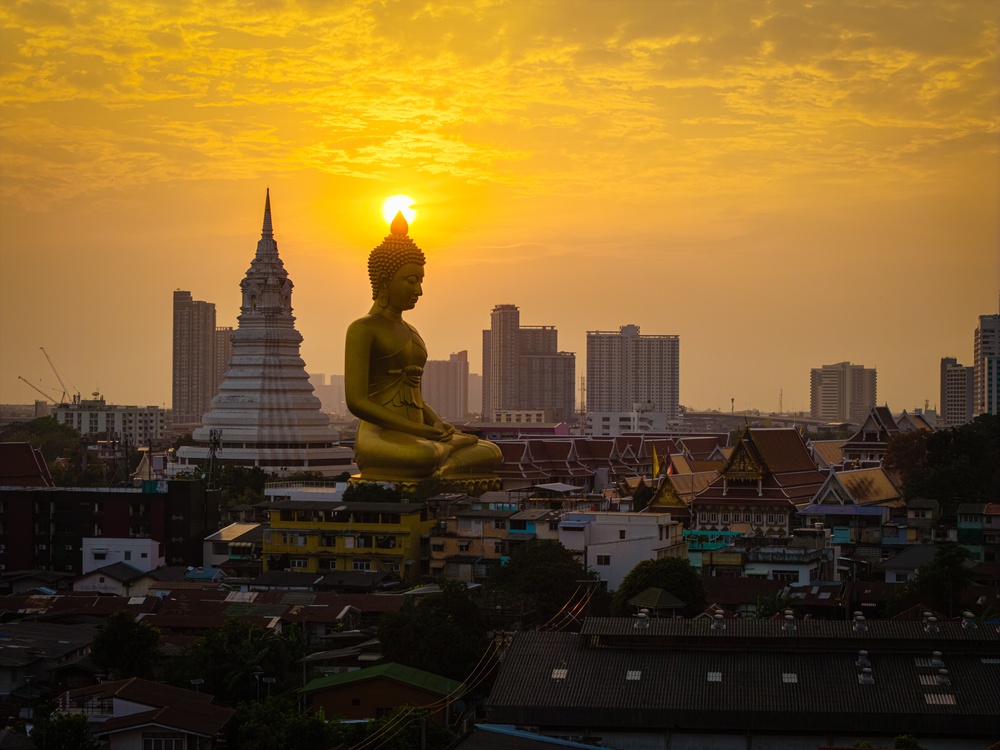
The main stupa, in Rattanakosin style, dominates the entire complex. Its whiteness contrasts sharply with the surrounding vegetation. You can walk around it completely to observe the niches housing Buddha statues.
The artificial hill (Khao Mor)
This landscaped mound, dotted with temple miniatures and caves, is unique in Bangkok's temple landscape. It illustrates Buddhist cosmology and serves as a meditation space for the faithful.
The turtle pond
The pond's turtles are released by Buddhists practising merit-making. Witnessing this daily ritual offers a tangible insight into Thai popular devotion, away from standardised tourist circuits.
Etiquette and visiting rules
- Cover your shoulders and knees before entering; avoid see-through clothing.
- Remove your shoes before entering the ubosot and main buildings.
- Speak quietly; the temple is active, monks live and pray here.
- Do not touch Buddha statues and do not sit with your back to them for photographs.
- Women should not touch monks nor hand them objects directly.
Photography tips
Morning light (before 9am) is ideal for photographing the white chedi without backlighting. The artificial hill offers original framing with its miniatures and vegetation. Inside the ubosot, light is dim: a camera with high ISO sensitivity is useful. Photography is generally permitted in outdoor spaces; check signage at the entrances to closed buildings.
Location and access
Wat Prayurawongsawas is located on the western bank (Thonburi) of the Chao Phraya, in the Bang Rak / Khlong San neighbourhood. The nearest pier is Tha Rachini (Pak Klong Talat), served by orange and yellow express boats. From there, the temple is reachable on foot in a few minutes. Coming from the historic centre (Rattanakosin), a shuttle boat from Tha Tien or Tha Chang allows you to combine the visit with Wat Pho or the Grand Palace.
Nearby
- Wat Pho — On the opposite side of the river, the temple of the reclining Buddha, one of Bangkok's largest religious complexes.
- Grand Palace — The royal palatial complex, a few minutes by boat, unmissable for understanding Thai monarchy history.
- Pak Klong Talat — Bangkok's flower market, open at night, a stone's throw from the pier.
- Santa Cruz Church — A vestige of Bangkok's Portuguese community, in the same Thonburi neighbourhood.
Frequently asked questions
Admission is free for all visitors. Respectful dress is, however, mandatory.
The most convenient way is by express boat on the Chao Phraya to Tha Rachini (Pak Klong Talat) pier, then a few minutes on foot. Taxi and tuk-tuk are also possible from the centre.
Yes. A shuttle boat connects the Thonburi bank to Tha Tien (Wat Pho) or Tha Chang (Grand Palace). The combination is feasible in half a day.
Covered shoulders and knees are mandatory. Sarongs are usually available at the entrance if your clothing is not suitable.
Outdoor spaces are generally accessible, but the artificial hill has stairs. Access to main buildings may require crossing high thresholds.
The dry season (November to February) offers the most pleasant conditions: moderate heat and clear skies. Avoid the hottest hours during the dry season (11am–3pm).
Interested in this visit?
We can include it in your personalised itinerary.