The Death Railway: History, Journey & Practical Guide
The Death Railway: History, Journey & Practical Guide
Built in 1942-1943 by the Japanese at the cost of thousands of lives, the Death Railway connects Kanchanaburi to Nam Tok along the Kwaï River.
Nicknamed the "Death Railway," the Siam-Burma line linked Bangkok to Thanbyuzayat, in Mon State (Myanmar), over 415 kilometers. Constructed between 1942 and 1944 by the Imperial Japanese Army during World War II, it claimed the lives of at least 13,000 Allied prisoners of war and a far greater number of Asian workers. Today, the operational section departing from Kanchanaburi offers a journey that is at once railway, landscape, and memorial experience.
Why Visit the Death Railway
The Death Railway is far more than a tourist curiosity: it is an active memorial site, integrated into Thailand's railway network. Three key reasons inspire a visit:
- Understand a lesser-taught episode of World War II in Southeast Asia, through the Allied cemeteries and museums of Kanchanaburi.
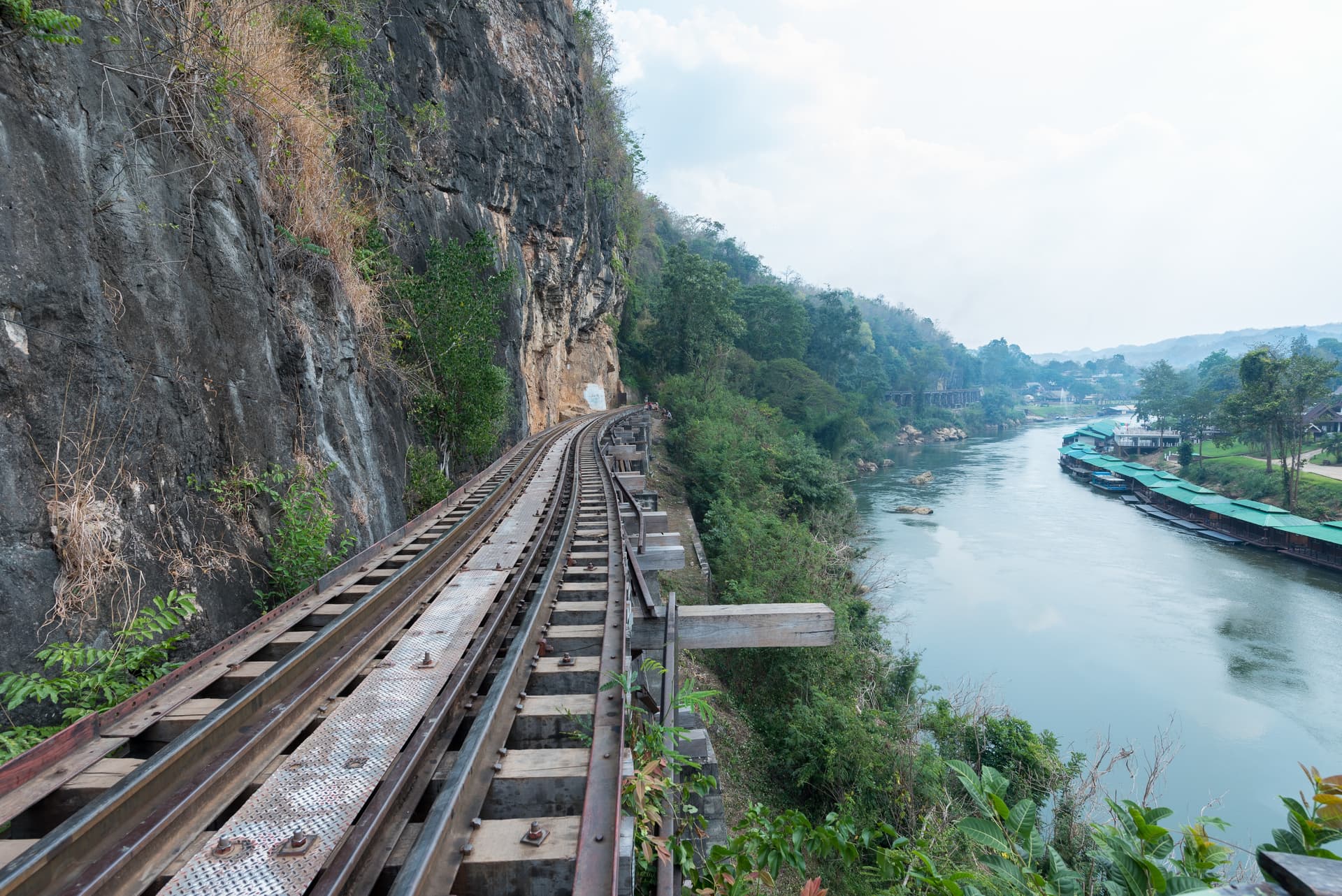
- Travel aboard an operational section between Kanchanaburi and Nam Tok, where the train hugs the cliff above the Kwaï Noi River along the wooden Wang Pho Viaduct.
- Blend history and nature by extending your journey to Erawan National Park or the Khao Sam Roi Yot protected area nearby.
History of the Death Railway
After Japanese forces occupied Thailand in 1941, the Imperial high command decided to link Siam to British Burma by rail in order to supply troops engaged on the Indo-Burmese front, avoiding dependence on maritime routes vulnerable to Allied submarines.
The construction project officially opened on September 16, 1942. Japanese engineers had initially estimated its duration at roughly three years; military orders compressed this to eighteen months. To meet this timeline across 415 km of jungle, rugged terrain, and waterways, the army mobilized nearly 100,000 Asian civilians (Burmese, Malays, Tamils, Javanese) and requisitioned approximately 60,000 Allied prisoners of war: British, Australian, Dutch, and American.
Working conditions were extreme: sixteen to eighteen-hour days, insufficient rations, corporal punishment, malaria, dysentery, cholera, and beriberi. At least 13,000 prisoners of war are estimated to have died on the project, with several tens of thousands more among civilian workers—figures still debated by historians. The line was completed in October 1943 and operated until the end of the conflict in 1945.
The Bridge on the River Kwai
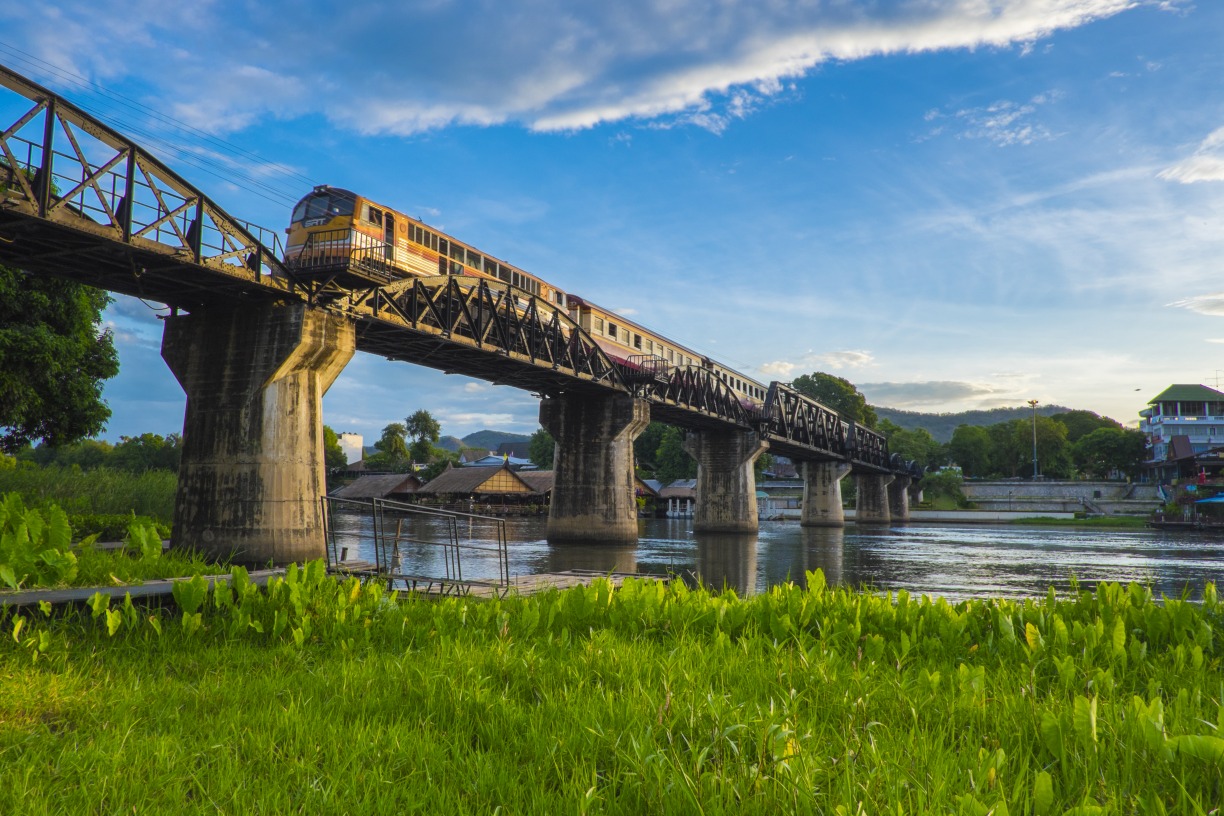
The railway bridge spanning the Kwaï Yai River at Kanchanaburi was initially built in wood, then reinforced with a prefabricated metal viaduct imported from Java. Bombed repeatedly by Allied aircraft in 1944-1945, it was rebuilt after the war: the curved sections visible today are original, while the rectangular center spans are post-war repairs. Pierre Boulle's novel (1952) and David Lean's film (1957) cemented its place in popular culture.
What to See
The visit unfolds in several complementary stages, typically spread over one to two days from Kanchanaburi.
- The Bridge on the River Kwai: you can cross it on foot between train passages. Floor markings indicate side shelters.
- The Wang Pho Viaduct (Tham Krasae): 300 meters long, it clings to the cliff above the Kwaï Noi River. This is the most spectacular section of the route.
- Nam Tok terminus: the operational line ends here, approximately 130 km from Kanchanaburi. Beyond this point, rails were dismantled after the war.
- Kanchanaburi War Cemetery: 6,982 graves of Allied prisoners, maintained by the Commonwealth War Graves Commission.
- JEATH War Museum and Thailand-Burma Railway Centre: two complementary museums displaying archives, personal effects, and reconstructions of barracks.
- Hellfire Pass (Konyu Cutting), approximately 80 km to the northwest: a hand-carved cutting through the rock, accompanied by an Australian memorial and interpretive trail.
Practical Information
Trains run several times daily between Kanchanaburi and Nam Tok. Tickets are purchased directly at the station for a modest fare to foreign travelers (ranging from tens to a hundred baht depending on the section). Allow approximately 2 hours to reach Nam Tok from Kanchanaburi.
A few key recommendations:
- Left side of the carriage in the Kanchanaburi → Nam Tok direction to enjoy views of the river below at the Wang Pho passage.
- No air-conditioned cars or dining service: bring water and sun protection. Street vendors offer fruit and snacks.
- Modest dress recommended for cemetery and museum visits, in respect of the memorial character of these sites.
- Allow a minimum of one day to combine train, bridge, and a museum; two days if including Hellfire Pass.
When to Go
The best period runs from November to February: milder temperatures (77-86°F), low humidity, clear skies that showcase the Kwaï landscapes. From March to May, heat intensifies, often exceeding 95°F in the valley. The rainy season (June to October) lushes the surrounding jungle but can occasionally disrupt rail traffic after heavy downpours. The River Kwai Bridge Week commemorations in late November-early December draw large crowds: plan accordingly based on your preference for solitude or celebration.
How to Get There
The historic route departs from Bangkok, at Thonburi Station (Bangkok Noi), on the west bank of the Chao Phraya. Two daily trains leave for Kanchanaburi and Nam Tok, with a journey time of approximately 3 hours to Kanchanaburi.
Alternative options:
- Minivan from the Sai Tai Mai Terminal in Bangkok to Kanchanaburi (roughly 2 hours), then boarding the Death Railway at Kanchanaburi or River Kwai Bridge station.
- Organized day trip from Bangkok, including transfers, train, and museum.
- Private car with driver to combine the Death Railway, Hellfire Pass, and Erawan National Park in a two-day loop.
Nearby Attractions
The Kanchanaburi region and neighboring Nakhon Pathom province offer several complementary sites:
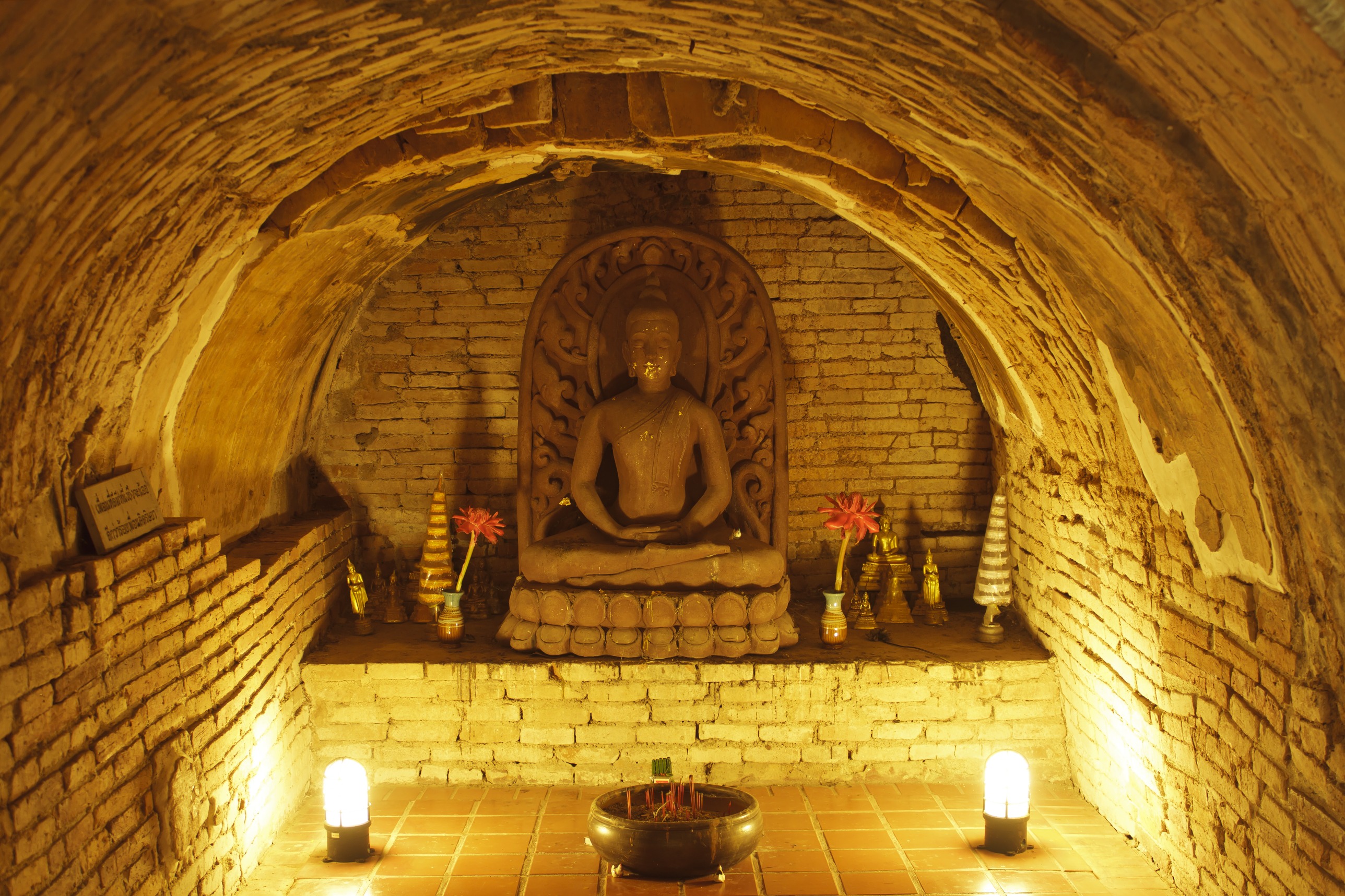
- Wat Ban Tham, a striking temple set within a cave south of Kanchanaburi.
- Chin Phrathanporn, a less-visited sanctuary nearby.
- Wat Phra Pathom Chedi, Thailand's tallest stupa, in Nakhon Pathom on the return route to Bangkok.
- Sanam Chan Palace, former residence of Rama VI, also in Nakhon Pathom.
- Wat Kanon Nang Yai Museum, dedicated to traditional shadow puppetry theater.
Frequently asked questions
The operational section ends at Nam Tok, approximately 130 km from Kanchanaburi. Rails beyond this point, extending to the Burmese border and Thanbyuzayat, were dismantled after 1945. It is not possible to reach Yangon by this line.
The historic departure point is Thonburi Station (Bangkok Noi) in Bangkok. Many travelers drive directly to Kanchanaburi by minivan, then board at Kanchanaburi or River Kwai Bridge station for the most scenic section to Nam Tok.
One day suffices to combine the Bridge on the Kwai, a train journey to Nam Tok, and a museum visit. Two days are preferable to include Hellfire Pass and the Allied cemeteries without rushing.
Traveling Kanchanaburi → Nam Tok, choose seats on the left side to enjoy views of the Kwaï Noi River during the Wang Pho Viaduct passage.
Because its construction between 1942 and 1943 resulted in the deaths of at least 13,000 Allied prisoners of war and tens of thousands of Asian civilian workers, victims of harsh working conditions, malnutrition, and tropical diseases.
To incorporate the Death Railway into a tailor-made itinerary combining Bangkok, Kanchanaburi, and northern Thailand, explore our Thailand journeys.
Photos
Interested in this visit?
We can include it in your personalised itinerary.