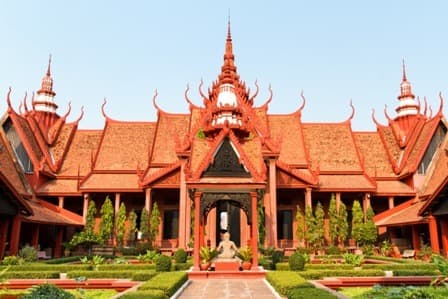
National Museum of Cambodge
National Museum of Cambodge
Neighbouring the Royal Palace of Phnom Penh, the National Museum houses over 14,000 pieces of Khmer art, from the 4th century to the post-Angkorian period.
Neighbouring the Royal Palace in central Phnom Penh, the National Museum of Cambodge houses one of the world's most important collections of Khmer art. The ochre building, designed in traditional Khmer style and inspired by Angkorian art, contains over 14,000 pieces arranged around a central courtyard.
Why visit the National Museum
The museum offers a comprehensive overview of Khmer sculpture from the 4th century to the post-Angkorian period. For a traveller preparing to explore the Angkor sites or returning from them, it is a valuable supplement: major pieces removed from temples are seen in a museum setting, presented with appropriate lighting and signage. The courtyard gallery, planted with lotus pools, also offers a respite from the capital's traffic.
History of the museum
The institution was founded in 1914, at the initiative of Albert Sarraut, Governor General of Indochina, who entrusted the project to French archaeologist and ethnologist George Groslier. Built between 1917 and 1920, the building adopts the vocabulary of traditional Khmer architecture; the motifs of the two large portals are copied from the temple of Banteay Srei.
The museum opened partially in 1918 and was inaugurated under the name Musée Albert Sarraut by King Sisowath on 13 April 1920, on the occasion of the Khmer New Year. George Groslier became its first curator.
Shortly before Cambodge's independence in 1953, France handed over the direction of the institution to Cambodian authorities. Renamed National Museum of Cambodge, it was renovated in 1968 under the supervision of Vann Molyvann, a leading figure of the New Khmer Architecture movement.
From April 1975 onwards, the building was abandoned under the Khmer Rouge regime. The damaged roof allowed a large colony of bats to settle, and an inventory conducted in 1980 revealed the disappearance of entire collections. The patient reconstruction of the collection explains why some rooms are occasionally incomplete.
What to see in the collections
The ground-level galleries, arranged around the courtyard, occupy approximately 2,800 m². The tour follows a chronological logic combined with a material-based approach.
A journey through four periods
- Prehistory (objects dating from the 4th to 9th century): tools, ancient ceramics.
- Pre-Angkorian period (9th-10th century): early large Hindu sculptures.
- Angkorian period (10th-14th century): heart of the collection, deities, lintels and pediments from temples.
- Post-Angkorian period (after 14th century): late Buddhist sculpture and decorative arts.
Four material categories
- Stone: monumental statuary, lintels and bas-reliefs removed from temples, depicting mythology, historical events and scenes of daily life.
- Metal: bronzes representing Hindu and Buddhist deities, ritual objects and everyday items; the subtle colour variations reveal alloys of gold, silver and copper.
- Wood: sculptures and architectural elements, more fragile, often post-Angkorian.
- Ceramics: decorative tiles, ritual vases and tableware, with remarkable pieces in zoomorphic forms.
Major pieces to discover
- A sandstone statue of Shiva holding Uma on his lap, in the Banteay Srei style (late 10th century).
- An eight-armed Vishnu measuring 1.93 m.
- A statue of Harihara dating to the 6th century.
- A sculpture of Jayavarman VII from Angkor Thom, characteristic of the Bayon period (late 12th-early 13th century).
Practical information
- Duration of visit: allow 1.5 to 2 hours for a complete tour.
- Opening hours: open daily, with continuous hours and last admission approximately half an hour before closing (confirm on arrival).
- Guided tours offered in Khmer, English, French and Japanese.
- Photography permitted only outside and in the courtyard; forbidden in the galleries.
- On site: gift shop (art books, replicas, postcards) and café located in the courtyard.
How to get there
The museum is located on Street 13, between Streets 184 and 178, immediately north of the Royal Palace. The visitor entrance is at the corner of Streets 13 and 178. From most hotels in central Phnom Penh, access is on foot, by tuk-tuk or motodop (motorcycle taxi); ride-hailing services such as PassApp and Grab also serve the address.
What to see nearby
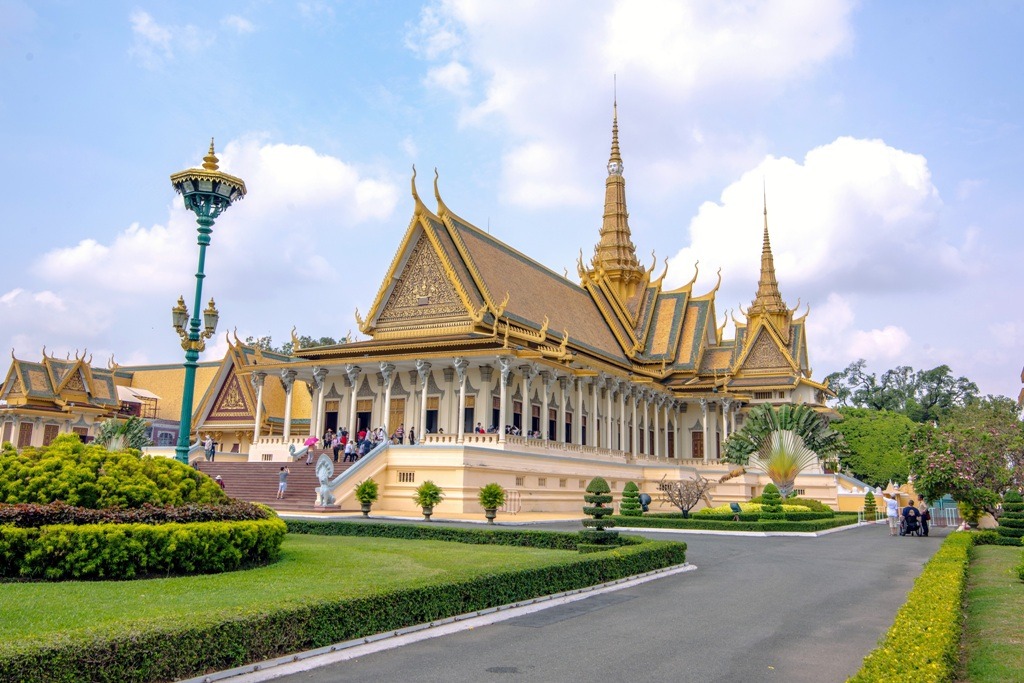
- The Royal Palace and Silver Pagoda, adjacent to the museum.
- The city of Phnom Penh and its colonial quarters, accessible on foot.
- To extend your tour beyond the capital: the Bayon temple at Angkor, from which several sculptures in the museum originate.
Frequently asked questions
Frequently asked questions
Extend your visit to Cambodge
The National Museum is a key stop on an itinerary that combines Phnom Penh, the temples of Angkor and the landscapes of the south. To build a journey that connects the capital to these sites, consult our itineraries in Cambodge.
Interested in this visit?
We can include it in your personalised itinerary.