The Temples of Angkor
The Temples of Angkor
Everything you need to prepare your visit to the Angkor temples: history, must-see sites, pass rates, best time to visit, and advice from a local expert.
Set in the midst of the Tonlé Sap tropical jungle, Angkor sits 7 km from the city of Siem Reap. It stands as one of the main tourist attractions in Cambodia. Rising from within a majestic forest, it reveals the largest and most expansive religious complex in Southeast Asia. It is also among the world's finest archaeological sites. The majority of structures found here hold great architectural, archaeological, and artistic significance for Khmer culture.
History
The Khmer empire was founded in 802 by Jayavarman II. During this empire's period of prosperity, Angkor was its capital, a region once dominated by the Chams.
Under the reign of Yasovarman, son of Indravarman, the Angkor region embraced its true prosperity. Often nicknamed the "creator of Angkor," he undertook ambitious projects such as the construction of dikes and the erection of monuments. For more than 600 years of dominion, the Angkor kingdom expanded eastward to the southeastern tip of Asia, westward to Burma, and eastward to Vietnam. The kingdom then covered approximately 1,000 km² and was home to nearly 750,000 inhabitants.
With the decline of the Khmer kingdom, the capital of Angkor was abandoned around 1431. Subsequently, its temples were also invaded by the lush vegetation of the Tonlé Sap jungle.
Since 1992, this vast historical complex has been inscribed as a UNESCO World Heritage Site. In order to protect this heritage from looters, the international body launched the Angkor Conservation Program in 1993 and decided to transfer several artifacts from the site to the National Museum in Phnom Penh.
Discovering the Angkor Site
Spanning more than 400 km², the Angkor site today stands as a vast archaeological ruin and an immense collection of ancient remains shared between Hindu belief and Buddhist thought. The zone comprises three sections: central, eastern, and northeastern. It contains approximately 40 temples of Hindu or Buddhist style. It also features hydraulic structures including basins, dikes, reservoirs, and canals.
Through these temples and hydraulic systems, Angkor bears witness to the ingenuity and nobility of Khmer architecture. These attractions indeed highlight the social hierarchy, cultural, religious, and symbolic value within the Khmer empire. Facing east, the central structure of each temple is oriented toward the position of Mount Meru.
To fully appreciate the beauty of the site, it is most enjoyable to fly over the Angkor zone aboard hot air balloons or helicopters. During sunset, the view of all the temples and Angkor's remains reflects a breathtaking image. For those without the means, they can indulge in this luxury by spending 50 US dollars for a 6-minute flight.
What to See?
As the cultural and administrative center of the Khmer empire, Angkor houses a great number of monuments marking its period of prosperity. For this reason, it contains hundreds of temples, palaces, and basins. Angkor Wat, Bayon, Ta Prohm, Preah Khan, and Banteay Srei are the most important and most visited sites within the complex.
Angkor Wat
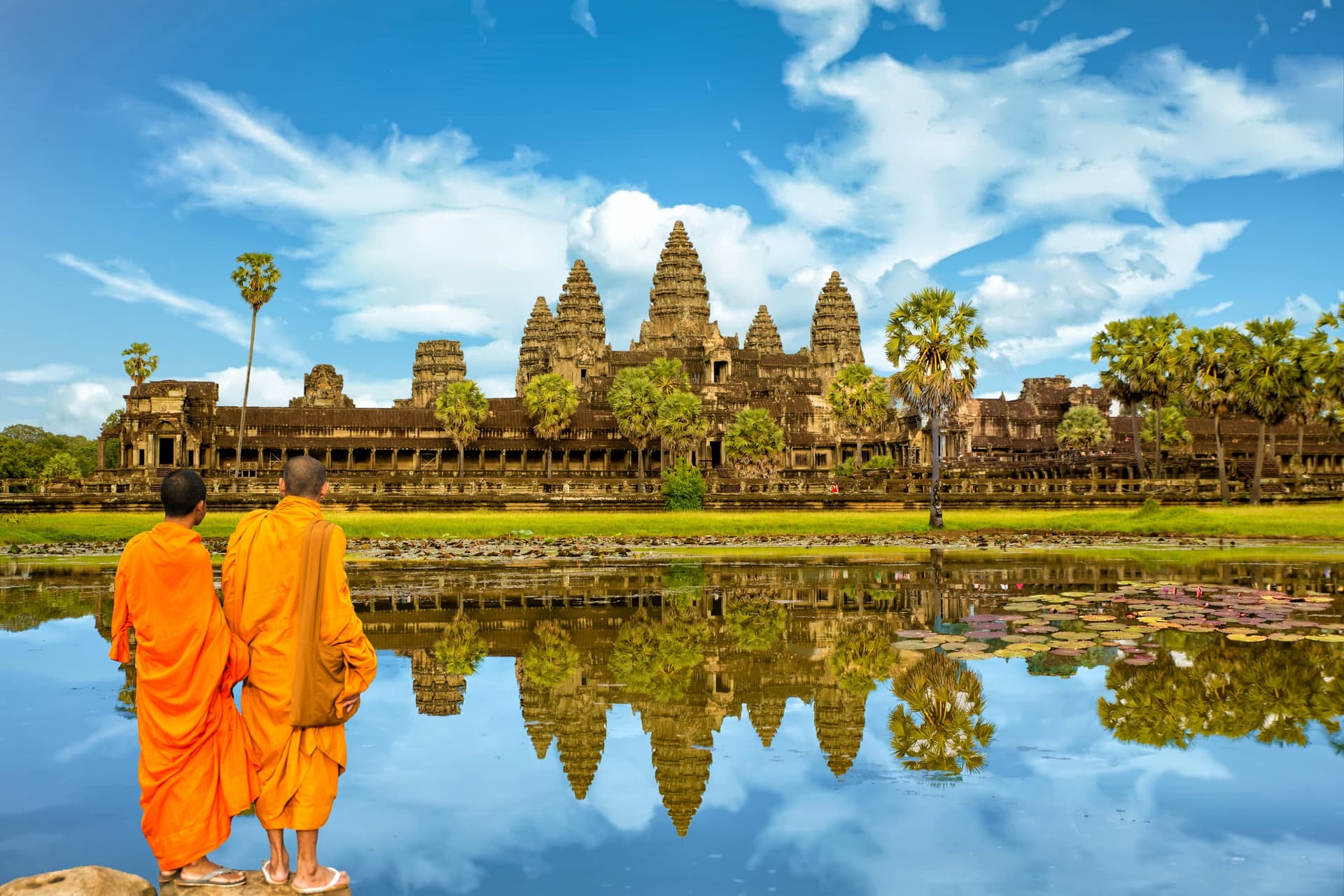
With a total length of 1,500 m and a width of 1,300 m, Angkor Wat is the most sophisticated temple in the complex and the largest religious monument in the world. Built in the 12th century by King Suryavarman II, this site was originally a Hindu temple and was converted to Buddhist worship around the 14th century. Today, it is frequented by Buddhist monks.
Meticulously decorated, this place is a religious sanctuary. It is the best-preserved temple at Angkor. Every corner of the site is thus covered with sculptures depicting gods, men, and animals, most of which mark the history and culture of the Khmer people. Borders, moldings, and capitals are also adorned with floral decorations. At sunrise or sunset, this attraction has become an unmissable destination for site visitors. Through the reflection of the sun, the image of the building at that moment rivals the work of a great artist.
Bayon
Bayon is also among the must-see attractions of the site. Located at the heart of Angkor, north of Angkor Wat, this place is a Buddhist temple well-known for its large sculptures of Buddha's faces. During your visit, you can enjoy counting the 216 Buddha heads carved on four-sided pillars. Today, the temple has only 37 pillars visible and standing.
Ta Prohm
Located in the eastern part of Angkor and invaded by vegetation, Ta Prohm is considered a natural site. Here you will find century-old trees called "Tetrameles nudiflora" whose roots are literally interwoven between the stones above the temples. Their massive roots cover the temple and attempt to create a mystical image.
Preah Khan
Occupying an area of 56 hectares, Preah Khan was the center for the dissemination of Khmer culture. It was a Buddhist university at Angkor dedicated in honor of Jayavarman VII's victory over the Chams. During the golden age of the Angkor empire, it welcomed more than 1,000 teachers.
Banteay Srei
Recently restored, the small temple of Banteay Srei was built in 967 to honor the divinity Shiva. In contrast with other temples, this monument stands out through its relief sculptures. Almost every corner is entirely decorated with relief designs. While visiting this monument, it is also very important to carefully observe the door lintels which bear engravings framing scenes from Brahmanical mythology.
Airplane
Siem Reap remains the closest city to the Angkor site with an international airport. It is therefore easier to reach this city by plane.
Given the vastness of the site, it is advisable to take a means of transportation to explore this great complex comfortably. You can take tuk-tuks or motorbike taxis. These are the only motorized vehicles permitted to travel within the complex.
Hours and Rates
To better visit the temples and fully discover the entire park, it is recommended to plan ahead and purchase a ticket in advance. There are three pass categories: a 72 US dollar ticket valid for 7 days, a 62 US dollar ticket valid for 3 days, or a 37 US dollar ticket for 1 day. The entrance ticket will be checked at each entry point to Angkor attractions. Admission to the site is free for children under 12 years old.
At the entrance, the site provides English-speaking tour guides to foreign tourists. To benefit from the guides' services, you must pay 25 US dollars for a full day.
The main entrance to Angkor is open from 05:00 until 18:00.
What to Do?
- Board hot air balloons or helicopters to appreciate the architecture and tranquility of the surrounding environment.
- Explore the entire Angkor domain and discover the history and culture of Khmer Buddhism through the temples.
Want to discover this destination?
Our local advisors design your tailor-made trip.