Ta Prohm
Ta Prohm
A 12th-century Buddhist temple within the Angkor park, Ta Prohm is celebrated for its ruins enveloped by strangler figs and its role in Tomb Raider.
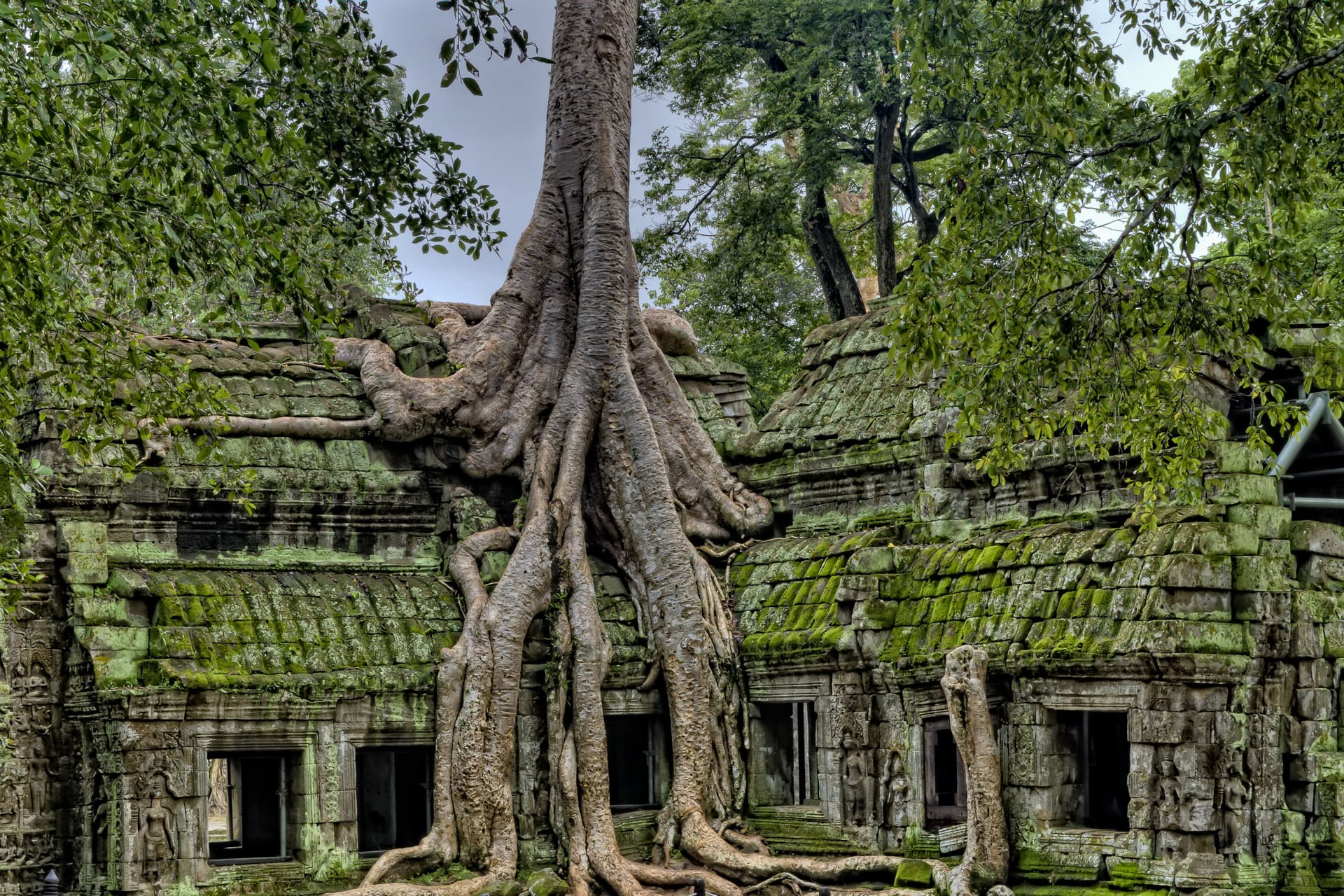
A 12th-century Buddhist temple located within the Angkor complex, a few kilometres east of Angkor Wat, Ta Prohm stands out for the strangler figs and tetrameles nudiflora that envelop its ruins. The French School of the Far East chose to preserve the site in this state, blending sandstone with vegetation, making it one of the most recognizable temples in Cambodia.
Why visit Ta Prohm
Three reasons make this visit worthwhile as part of the Angkor circuit:
- A unique state of conservation: unlike other restored temples, Ta Prohm was stabilized without removing the centuries-old trees that have grown on its walls.
- Well-documented royal history: a stele found on site details the temple's life at its height, its riches and population.
- Cinematic fame: the filming of Tomb Raider in 2001 earned it the nickname "Angelina Jolie's temple" and made it known beyond circles of Khmer archaeology enthusiasts.
History
Ta Prohm was constructed from 1186 under the reign of Jayavarman VII, as part of the grand architectural programme launched by this Buddhist king. Its original name, Rajavihara, means "the king's monastery"; the site was previously called Old Brahma. The main idol represented Prajnaparamita, the personification of wisdom, whose features are believed to have been inspired by the king's mother. Ta Prohm thus forms a pair with the temple of Preah Khan, founded in 1191 and dedicated to a Bodhisattva inspired by the king's father.
A stele discovered on site indicates that at its height, the temple housed over 12,500 people, including 18 high priests and 615 dancers. Some 80,000 inhabitants of surrounding villages contributed to its upkeep through services and supplies. Inscriptions mention treasures of gold, pearls and silk. Expansions and reconstructions took place in the late 13th century.
After the fall of the Khmer Empire in the 15th century, the temple was abandoned and the jungle reclaimed it. When the French School of the Far East undertook the conservation of the Angkor temples in the 20th century, it decided to leave Ta Prohm in its original state, with its trees and ruins. The site was inscribed on the UNESCO World Heritage list in 1992. Since 2013, the Archaeological Survey of India has conducted a restoration programme to stabilize the most fragile structures without altering the temple's appearance.
What to see on site
The temple extends over approximately 60 hectares (1 km by 700 m) and consists of five successive enclosures, each marked by a gopura, a decorated gate with four-faced towers in a style similar to that of Angkor Thom.
The trees and ruins
Two species dominate the site and contribute to its atmosphere: the strangler figs with silvery-white trunks and the tetrameles nudiflora, whose massive roots coil around the galleries. In the first enclosure, an emblematic tetrameles appears to crush the roof of a gallery; its hand-like roots plunge towards the ground while supporting the roof they oppress.
The hall of dancers
In the third enclosure, lintels decorated with sculptures of Apsaras (celestial dancers) mark the entrance to a hall dedicated to them. This is one of the temple's best-preserved sculptural decorations.
The central sanctuary and courtyards
Heavily damaged, the central sanctuary occupies the central courtyard, accessed after passing through several gopuras and crossing a large sandstone terrace in the second enclosure. The ruins of monastic buildings, carved pediments and collapsed roof blocks punctuate the path, giving a progressive sense of the complex's organization.
The founding stele
Near the main temple, the carved stele detailing Ta Prohm's foundation and operation remains one of the most valuable sources for understanding daily life in a great Khmer monastery of the 12th century.
Practical information
- Ticket: a visit to Ta Prohm is included in the Angkor pass (1, 3 or 7-day passes), which must be kept with you for checks at temple entrances.
- Duration of visit: allow 1 to 1.5 hours on site to cover the main enclosures.
- Dress code: shoulders and knees covered, as in all temples on the site.
- Comfort: closed shoes recommended, as the ground is uneven with roots and stone blocks. Water and a hat are essential.
When to visit
The best period runs from November to March, during the dry season, with more bearable temperatures and little rain. To limit crowds, favour early morning or late afternoon: the low light also better highlights the play of roots on stone. Avoid midday hours, which are hotter and busier with tour groups.
How to get there
Ta Prohm is located in the Angkor archaeological park, about 20 minutes by vehicle north of Siem Reap city centre. From Phnom Penh, several bus companies serve Siem Reap daily; allow 6 to 7 hours of travel. Once there, the tuk-tuk remains the most practical way to combine Ta Prohm with other temples; cycling is an alternative for shorter circuits.
To combine in the surrounding area
Ta Prohm naturally fits into a circuit of several Angkor temples:
- Angkor Wat: the largest religious complex on the site, best seen at sunrise.
- Preah Khan: Ta Prohm's twin temple, dedicated to Jayavarman VII's father.
- Baphûon: temple-mountain located within Angkor Thom.
- Pre Rup: laterite temple renowned for its sunsets.
- Banteay Samre: a more remote temple, less crowded.
Frequently asked questions
Frequently asked questions
The temple served as the setting for several scenes in the film Tomb Raider (2001), in which Angelina Jolie played Lara Croft. This filming contributed to its international fame, to the point that the nickname has stuck with guides and travellers alike.
No, access is included in the Angkor pass (1, 3 or 7 days), which also grants access to other temples in the archaeological park.
A leisurely visit requires approximately 1 to 1.5 hours. Archaeology or photography enthusiasts may wish to spend a bit more time.
No. The conservation approach, defined by the French School of the Far East and continued by the Archaeological Survey of India, is to preserve the temple in its vegetation-overgrown state, limiting interventions to stabilizing threatened structures.
It was founded as a Mahayana Buddhist monastery under Jayavarman VII, dedicated to Prajnaparamita. As in many Khmer sanctuaries, Hindu elements coexist in the decoration and symbolism.
Plan your visit
Ta Prohm fits into any Cambodia itinerary centred on the Angkor temples and the Siem Reap region. To build a tailor-made circuit including this temple and other major sites in the country, consult our trips to Cambodia.
Interested in this visit?
We can include it in your personalised itinerary.