Khong Chiam
Khong Chiam
At Thailand's eastern edge, Khong Chiam aligns national parks, ancient rock paintings, and a spectacular confluence where the Mekong meets the Mun River.
At Thailand's eastern edge, where the Mekong marks the border with Laos, the district of Khong Chiam lives by the rhythm of the river and rice paddies. Its national parks, thousand-year-old rock paintings, and fishing villages make it a precious stop for those wishing to explore Isan off the beaten path.
At a glance
| Country | Thailand, Ubon Ratchathani Province |
| Population | 33,000 inhabitants |
| Access | 80 km from Ubon Ratchathani (1h30 by minibus, 80 baht) |
| Recommended duration | 2 to 3 days |
| Best time to visit | November to February (dry season) |
| Must-sees | Pha Taem, Khaeng Tana, two-color river confluence, Wat Tham Khuha Suwan |
| Average budget/day | 30-60 € excluding luxury accommodation |
Why visit Khong Chiam?
Nestled on the border between Thailand and Laos, Khong Chiam remains a quiet village, isolated from major tourist crowds and lost in mountain foothills. The Mekong joins the Mun River here, forming the famous confluence nicknamed two-color river, where brown and blue waters meet without immediately mixing.
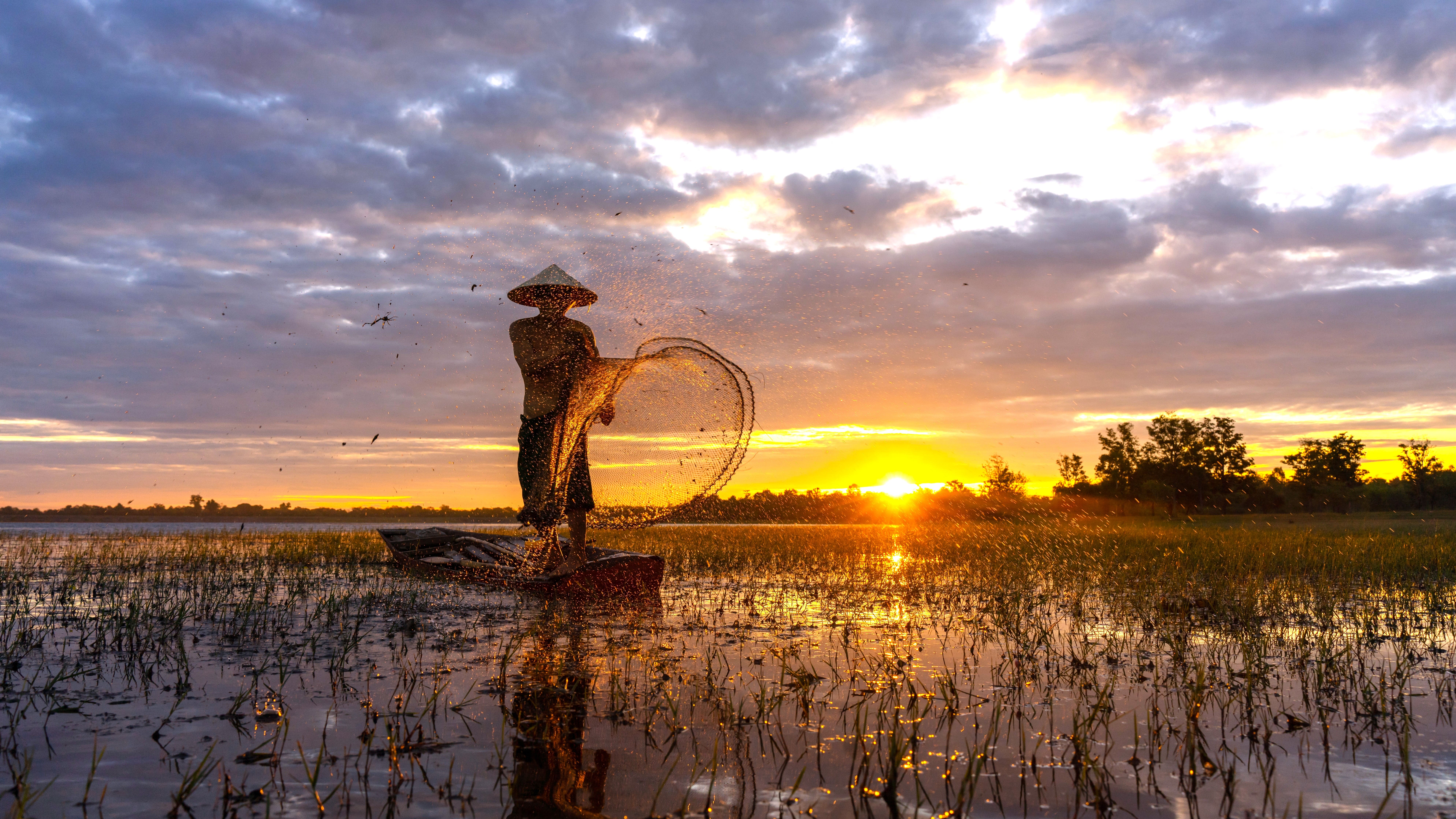
Prehistoric paintings dating back 3,000 to 4,000 years BC color the cliffs of Pha Taem park. A boat trip is magical, as the green of rice paddies contrasts against the brown waters of the Mekong. Fishing villages show that a lifestyle in communion with nature remains possible, just kilometers from the Laotian border.
For whom?
- Nature lovers: two national parks (Pha Taem and Khaeng Tana) to explore by hiking, kayak, or boat.
- Photographers: sunrise over Pha Taem, Thailand's first point to see daylight, and two-color river confluence in golden light.
- Off-the-beaten-track travelers: few foreign tourists, genuine immersion in rural Isan.
- History enthusiasts: rock art at Pha Taem among the oldest on the Indochinese peninsula.
- Slow travelers: cycling, traditional fishing, wildlife observation.
Historical notes
Today's Khong Chiam is the result of administrative reorganization. Originally, the tambons Pho Klang, Khong Chiam, and Huai Yang were united under Si Mueang Mai district. The historic center of Si Mueang Mai was particularly what was called "Khong Chiam." The current site bore a different name at the time. Toward the late 1950s, the three tambons sought independence and formed a territorial entity under the name Ban Dan.
The district's birthday is December 11, 1959, when it was officially proclaimed "amphoe." Twelve years later, in 1971, Ban Dan took the final name of Khong Chiam while the former historic quarter became "Si Mueang Mai."
As for the name itself, Khong could translate as "herd of elephants" and Chiam as "respect." The name thus refers to "a city where large herds of elephants live."
Khong Chiam today
Khong Chiam is one of twenty-five districts in Ubon Ratchathani, an eastern province of Thailand. It has nearly 33,000 inhabitants, the majority working in rice cultivation.
Low population density (32 inhab./km²), timid urbanization, and the mountain barrier explain the remarkable number of preserved natural sites. Agricultural activities intensify along the Mekong, whose landscapes combine rice fields, lotus, fishing boats, and villages perched on hillocks. The district is home to two national parks where you can get close to nature.
The destination remains discreet among foreign travelers. High-end accommodations are few and the local pace is unhurried, which is precisely its charm: you encounter a rural Thailand, faithful to its traditions and regional cuisine.
Places of interest to visit
Khong Chiam concentrates exceptional natural and historical heritage. After a hike through the woods, a detour to a Buddhist place of worship enriches the experience.
Pha Taem National Park
A mountainous massif lends character to this 140 km² park. The hike passes through a succession of cliffs and eroded hills. The quality of the rock art is what made Pha Taem famous: prehistoric paintings offer a caricatured evocation of the lifestyle of the first humans who settled in the region. These are vivid red drawings engraved directly into the rock. Subjects often include still lifes, figures of men and animals, hunting or harvest scenes, or fishermen paddling in their boats.
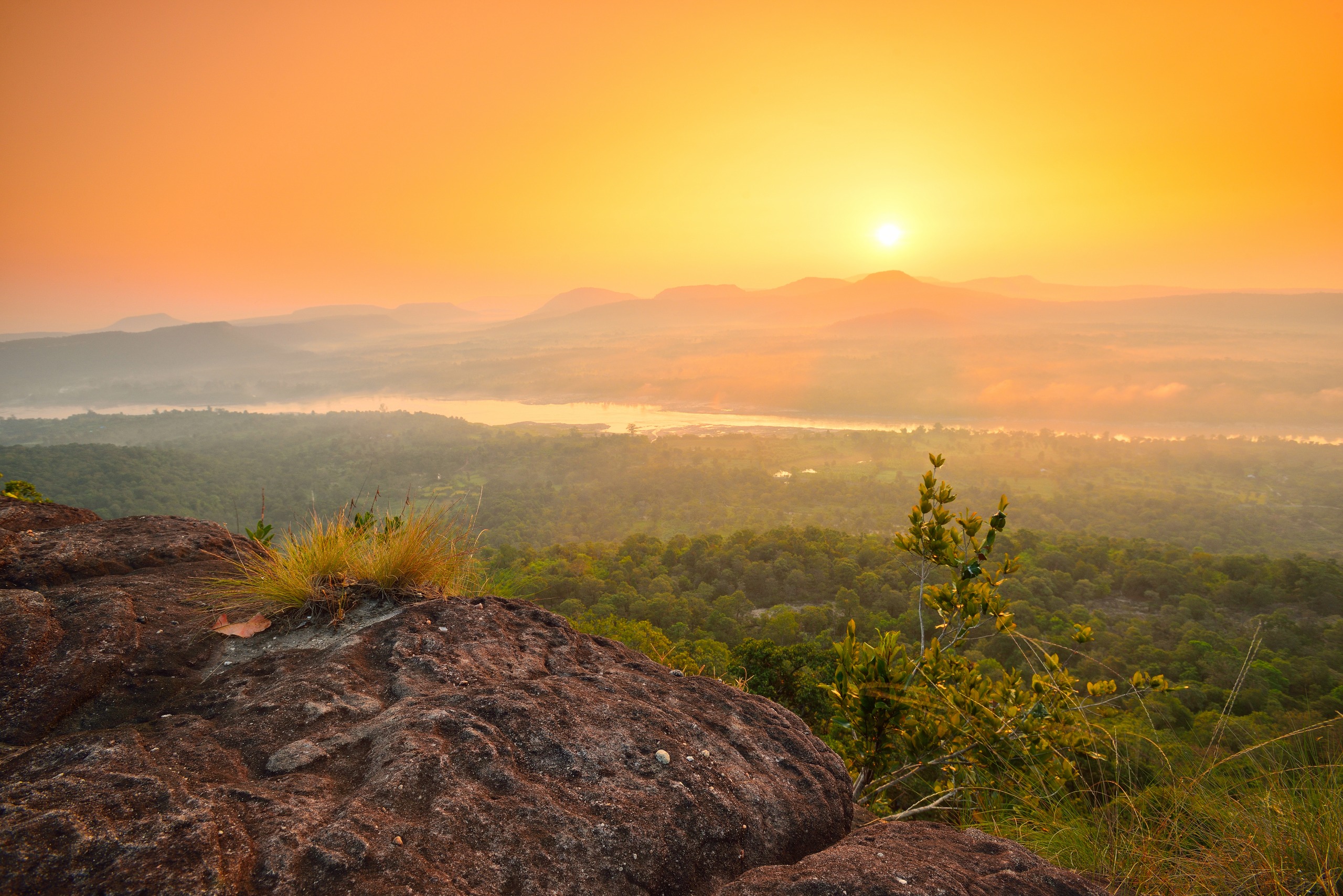
Beyond these paintings, the rock formations themselves hold a power of fascination. Erosion has sculpted squat blocks with mushroom-like appearances. The park is also known as Thailand's first point to see the sunrise: a panorama worth the detour, provided you arrive before 5:30 AM.
Khaeng Tana National Park
This protected site of 80 km² stretches along the Mun River. Its appeal lies in the large rapids that churn the river and clash at the foot of a rock. Rafting and kayaking enthusiasts venture there willingly. For those preferring calm, a downstream section allows for more peaceful paddling.
Forest walks also have their devotees. The canopy is dominated by evergreen dipterocarps. Along the way, encounters are unexpected: a serow grazing near a bush, a wild boar, a herd of barking deer, or a palm civet consuming tropical fruit.
The two-color river confluence
At the heart of the town, the Mekong meets the Mun River. The contrast between the brown waters of the river and the clearer waters of its tributary is visible several hundred meters before they mix—hence the nickname two-color river. A traditional boat trip allows you to approach the junction line and observe the Laotian bank, just across.
Wat Tham Khuha Suwan
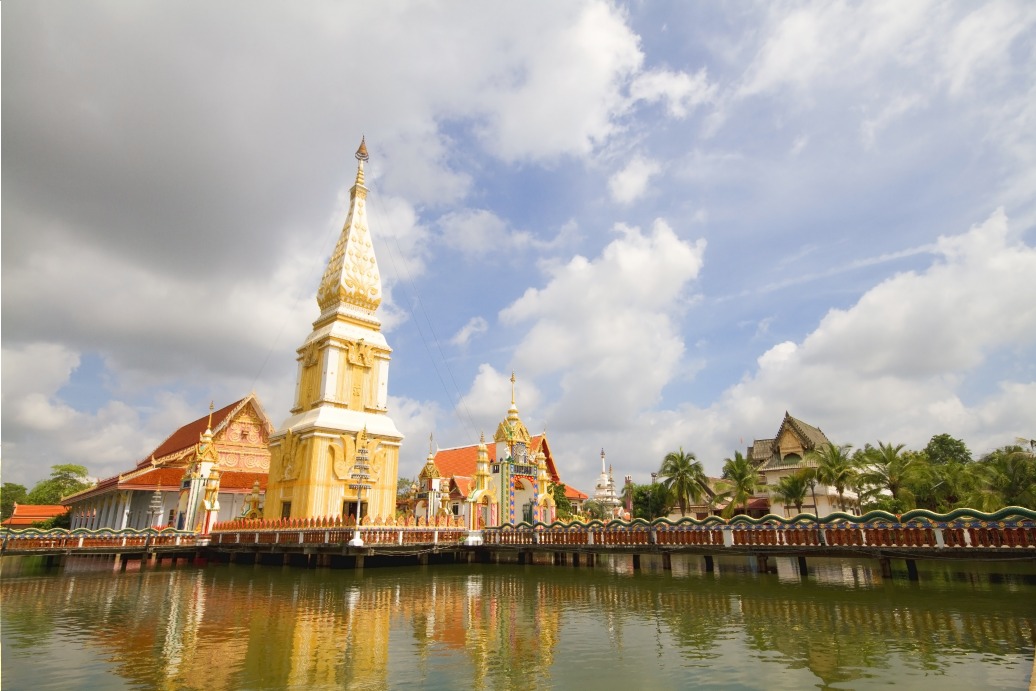
This Buddhist temple sits at the mouth of the Mun, where it joins the Mekong. An awe-inspiring view awaits at the end of a long staircase: the river with clear waters, typical farmhouses, and Laos embrace in a single glance. The monastery was founded in 1978 at the request of monk Luang Pu Kam Khaning Chula Mani, who wished a meditation retreat. His body has rested in the temple for several decades without decomposing—a fact that attracts pilgrims and the curious.
Insider tips
- Sunrise at Pha Taem: leave Ubon or Khong Chiam around 4 AM to reach the viewpoint before dawn. Bring a headlamp and a light fleece.
- Renting a scooter in Khong Chiam: it's the best way to connect sites (figure 200-250 baht/day). Otherwise, negotiate a tuk-tuk for a full day at 600-800 baht.
- Mekong waters: the two-color river confluence is more contrasted in the dry season (December-March), when the Mun River stays clear and the Mekong remains laden with sediment.
- Morning market: visit Khong Chiam market between 6 AM and 8 AM to taste khao niao (sticky rice) and local soups made with river fish.
- Laotian border: Laos is visible from several viewpoints, but there is no border post at Khong Chiam itself. The nearest crossing is via Chong Mek, about 1 hour's drive.
Where to stay?
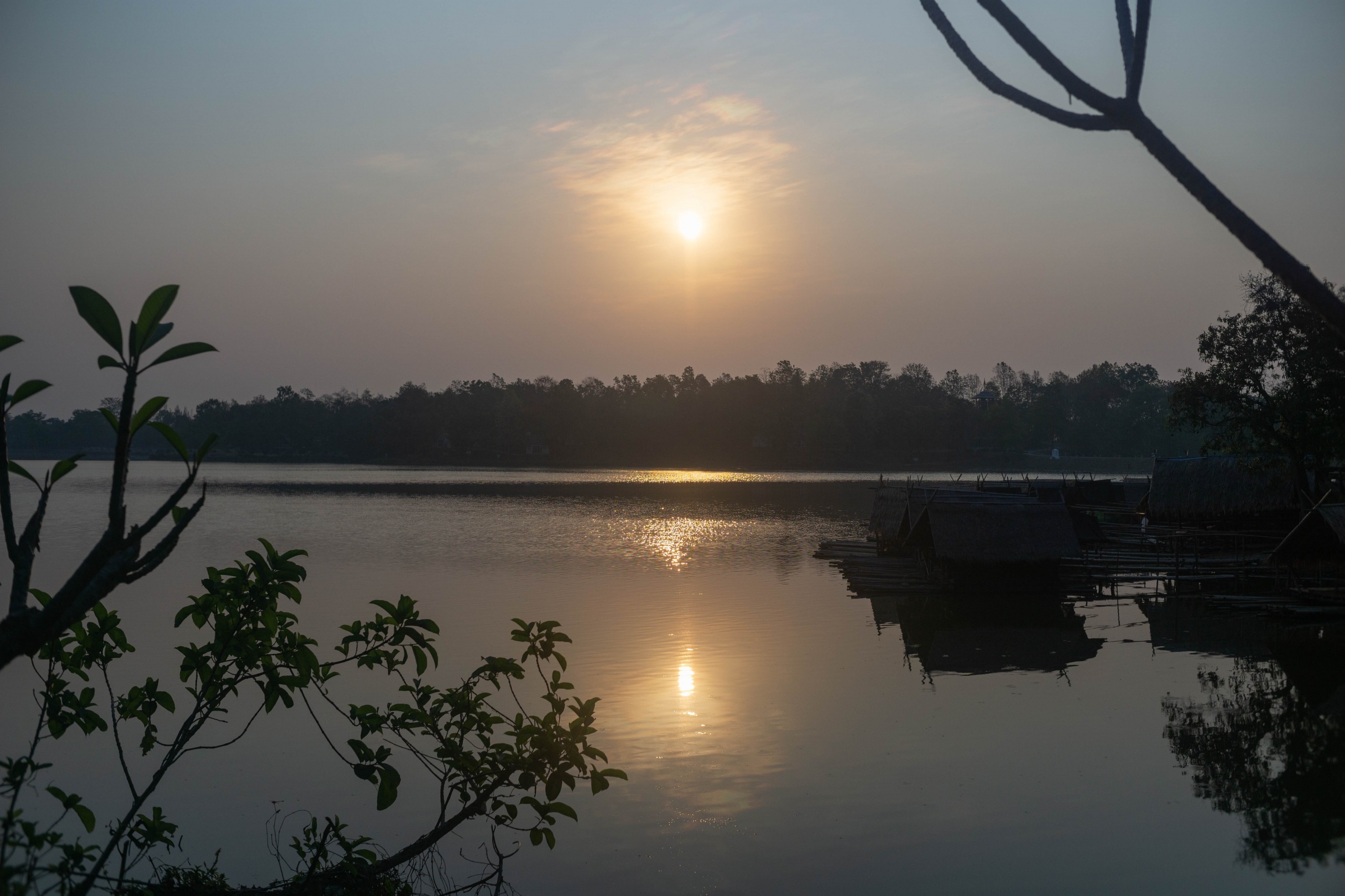
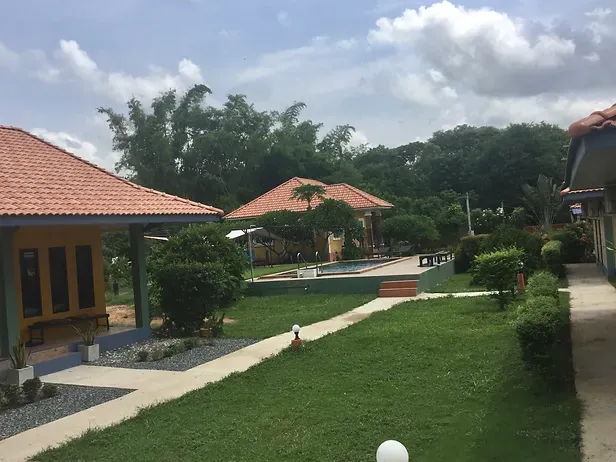
No international chain has yet established itself in Khong Chiam. Accommodation consists of small local structures, ideal for those seeking contact with residents.
- Guesthouses (15-30 €/night): simple family-run rooms, often by the Mekong. Minimal comfort but warm hospitality and home cooking.
- Boutique hotels and resorts (60-120 €/night): a few addresses offer wooden bungalows, terrace overlooking the river, and Thai breakfast. Booking recommended during high season.
- Upscale lodge (150 €+): still rare on-site. Many travelers combine one night in Khong Chiam and one night in Ubon Ratchathani, where hotel options are more developed.
For longer or more comfortable stays, it's common to lodge in Ubon Ratchathani and day-trip to Khong Chiam.
When to visit Khong Chiam?
Like northeastern Thailand, Khong Chiam experiences a rainy summer and dry winter. Temperatures remain warm year-round, averaging around 25°C.
- November to February — high season. Milder temperatures (20-28°C), low rainfall, clear skies. Ideal for hiking, sunrises at Pha Taem, and cruises on the Mekong.
- March to May — hot season. Dry heat potentially exceeding 35°C. Rock paintings remain accessible early in the morning.
- June to October — rainy season. Frequent afternoon showers, rice paddies at their greenest. Khaeng Tana rapids are impressive but rafting may be suspended for safety reasons.
How to get there and around?
Khong Chiam lies 80 km from Ubon Ratchathani city center. For time-pressed travelers, the simplest option is flying from Bangkok: Thai AirAsia, Thai Smile Air, and Nok Air operate several daily flights to Ubon Ratchathani (1 hour flight). Another option is the northeast rail network connecting the capital to Ubon Ratchathani and continuing to Laos.
From Ubon Ratchathani, simply head to the bus station, opposite the bazaar, where local minibuses to Khong Chiam pick up passengers. Allow 1 hour 30 minutes for 80 baht (about 2.24 €). Departures roughly every hour from 6 AM to 6 PM.
On-site, scooter rental (200-250 baht/day) remains the most practical option for connecting Pha Taem, Khaeng Tana, and Wat Tham Khuha Suwan. Otherwise, several tuk-tuk drivers offer full-day packages. The town center is easily explored on foot or by bike.
You would like to…
- Enjoy a kayaking excursion at Khaeng Tana National Park;
- Observe the rock art masterpieces at Pha Taem National Park;
- See mushroom-shaped eroded cliffs;
- Visit fishing villages on the Mekong's banks;
- Walk through lush rice paddies;
- Take a cruise on the Mekong to the two-color river confluence;
- Watch the sunrise at Pha Taem, Thailand's first point to see daylight.
Also discover
- Phibun (28 km) — small stopover town on the route between Ubon and Khong Chiam.
- Ubon Ratchathani (34 km) — provincial capital and essential gateway to eastern Isan.
- Yasothon (147 km) — famous for its annual Bun Bang Fai rocket festival.
- Nakhon Phanom (253 km) — another Mekong stopover, facing Laos.
- Khon Kaen (307 km) — major cultural city of Isan.
FAQ
Frequently asked questions
One day is enough to see the two-color river confluence and Wat Tham Khuha Suwan. Allow 2 to 3 days to explore Pha Taem at sunrise, hike at Khaeng Tana, and enjoy a boat ride on the Mekong.
The paintings are accessible year-round, but the dry season (November to February) offers the best hiking conditions and clear skies for sunrise. Avoid July-August rains, which make trails slippery.
Yes, several guesthouses (15-30 €) and a few boutique hotels (60-120 €) are available, often by the river. Travelers seeking more comfort stay in Ubon Ratchathani and visit Khong Chiam for the day.
Not mandatory, but a local guide greatly enriches a visit to Pha Taem (interpreting rock paintings, prehistoric context). At Khaeng Tana, a guide is recommended for whitewater kayaking outings.
There is no border post at Khong Chiam itself. The nearest international crossing is at Chong Mek (about 1 hour's drive), where you reach Pakse on the Laotian side.
Scooter rental (200-250 baht/day) remains the most flexible option for connecting Pha Taem, Khaeng Tana, and temples. Otherwise, several tuk-tuk drivers offer full-day packages (600-800 baht).
The contrast between the Mekong and Mun River waters is most striking in the dry season (December to March). During the rainy season, both waterways take on similar hues and the phenomenon becomes less photogenic.
Plan your trip to Khong Chiam
Khong Chiam fits naturally into a broader circuit through Isan and southern Laos. Our local agency Sawa Discovery helps you build a tailor-made itinerary combining Ubon Ratchathani, the Mekong, and a crossing to Pakse. From northeast Thailand to southern Laos (14 days, from 1490 €) and The trio of South Asia (18 days, from 2090 €) both pass through this region. Discover the agency.
Photos
Accommodation in Khong Chiam
Want to discover this destination?
Our local advisors design your tailor-made trip.