Beng Mealea
Beng Mealea
A 12th-century Khmer temple left to the jungle, 42 km from Siem Reap. Architecture close to Angkor Wat, raw exploration atmosphere.
Located 42 km northeast of Siem Reap and 6.5 km southeast of Phnom Kulen, Beng Mealea is one of the most singular temples in the ancient Angkorian realm. Its name literally means "lotus pond." Built in the 12th century under Suryavarman II, it shares with Angkor Wat a common architectural style, yet distinguishes itself through its condition: largely abandoned to the jungle, it offers a raw encounter with stone, roots, and moss-covered bas-reliefs.
Why visit Beng Mealea
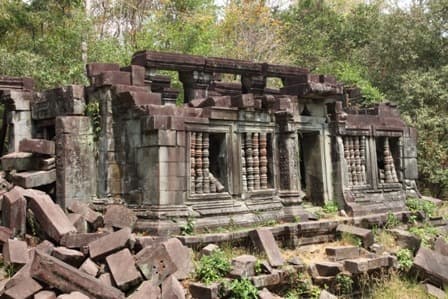
Beng Mealea is not a restored site. This is its main distinction from the grand temples of Angkor Park. Galleries have collapsed, sandstone blocks are scattered, and tropical vegetation has colonized the entire structure. This lack of restoration gives the temple an exploratory atmosphere that few other Khmer sites still preserve.
The site also remains apart from the massive tourist flow of Siem Reap, making the visit more contemplative than at Angkor Wat or Bayon. It notably served as a film set for Jean-Jacques Annaud's Two Brothers, which helped bring it to wider international attention beyond standard tour circuits.
Temple history
Beng Mealea was built between 1112 and 1152, during the reign of Suryavarman II, the same sovereign who erected Angkor Wat. Originally, the temple was dedicated to Hinduism and consecrated to Vishnu, as evidenced by its bas-reliefs and iconography.
Over the centuries, the sanctuary experienced a Buddhist reappropriation, visible in certain sculptures added later. This layering of two religious traditions is found in several temples throughout the region.
Historians emphasize the stylistic proximity between Beng Mealea and Angkor Wat, constructed in the same period. One hypothesis, though not reaching consensus, suggests that Beng Mealea may have served as a prototype or reduced model before the construction of the Angkorian capital. The similarities in layout, proportions, and techniques make the idea plausible, though it remains unproven.
What you'll see on site
The general layout
The temple is encircled by a massive moat 1.2 km long and 900 m wide. Oriented toward the east and built in blue sandstone, it is organized around three concentric enclosures housing libraries, galleries, a central sanctuary, and a cruciform terrace. The outer gallery extends 181 m long and 152 m wide, with corner towers reminiscent of those at Angkor Wat.
The bas-reliefs
On the lintels, pediments, and collapsed blocks, you'll find Hindu bas-reliefs depicting episodes from the Ramayana, as well as figures of Krishna, Yama, and Brahma. The cruciform terrace preserves balustrades adorned with Naga sculptures—those mythical serpents omnipresent in Khmer art.
Temple and jungle
The most striking element of the site remains the intertwining of architecture and vegetation. Two species dominate: the silk-cotton tree and the strangler fig. Their roots penetrate walls, lift flagstones, and ensnare columns. Wooden walkways have been installed above rubble to facilitate passage without further degrading the ruins.
Practical information
- Visit duration: allow 1 to 1.5 hours on site to explore the entire complex.
- Ticket: Beng Mealea is not included in the standard Angkor pass. A separate entrance ticket is required upon arrival. Moderate fee, payable in cash.
- Footwear: wear closed, grippy shoes. The ground is uneven, and sandstone blocks can be slippery after rain.
- Hours: open during daylight hours, morning through late afternoon. Best to verify locally before departing.
- Water and sun protection: limited stable shade; humidity is high year-round.
When to visit
The dry season, from November to March, remains the most comfortable: tolerable temperatures, passable trails, and clear light in the undergrowth. The rainy season (May to October) makes the jungle denser and more photogenic, but some passages become muddy and slippery.
For lighting, mid-morning and late afternoon offer the best contrast between stone, roots, and canopy. Visitor numbers remain moderate year-round compared to Angkor's main sites.
How to get there
Beng Mealea lies 42 km northeast of Siem Reap. From the city center, expect about 1 hour by car and 1.5 hours by tuk-tuk. Most visitors combine the site with other remote temples as part of a day excursion. Private car or minibus travel remains the most comfortable option, particularly when visiting multiple sites in sequence.
Nearby
Beng Mealea fits well into a circuit dedicated to Angkor's peripheral temples:
- Banteay Srey: the "temple of women," renowned for the delicate sculptures in pink sandstone.
- Banteay Samre: a 12th-century edifice with a style close to Angkor Wat, often less crowded.
- Bakong: a stepped pyramid from the Roluos group, a testament to pre-Angkorian Khmer art.
Frequently asked questions
Frequently asked questions
No. The site has its own entrance ticket, payable on arrival. The Angkor pass (1, 3, or 7 days) does not cover Beng Mealea.
A complete visit takes between 1 and 1.5 hours. Including round-trip travel from Siem Reap, budget a minimum of half a day.
Wooden walkways have been installed on part of the route. However, the ground is uneven, and some passages require stepping over blocks or roots. The visit is not well-suited for people with reduced mobility.
Include Beng Mealea in your trip
Beng Mealea perfectly complements a discovery of Angkor's grand temples with a rawer, quieter experience. To build an itinerary that combines Siem Reap, peripheral temples, and the rest of the country, consult our Cambodia journeys.
Interested in this visit?
We can include it in your personalised itinerary.