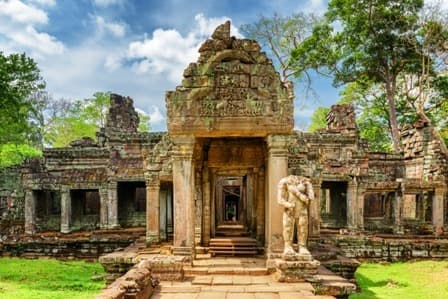
Preah Khan
Preah Khan
A 56-hectare temple-city founded in 1191 by Jayavarman VII, Preah Khan combines Buddhist history, monastic architecture and pristine atmosphere north of Angkor.
At the northern edge of the Angkor archaeological park, approximately 2 km northeast of Angkor Thom, Preah Khan ranks among the largest complexes ever erected under the ancient Khmer empire. More than a temple, this 56-hectare site was a genuine monastic city that housed a university.
Why visit Preah Khan
Preah Khan, meaning "the sacred sword" in Khmer, captivates with its raw atmosphere, still largely entwined by the roots of giant ceiba trees. The site attracts fewer visitors than Angkor Wat or Ta Prohm, allowing for a more intimate exploration of its galleries, cruciform halls and concentric sanctuaries.
Historically, the temple marks a turning point: it testifies to the golden age of Mahayana Buddhism under Jayavarman VII, followed by the Hindu reaction led by his successor. Its sculptures, gopuras and ground-level architecture—known as a "monastic complex"—make it essential to understanding Angkor.
History
Preah Khan was built between 1184 and 1191 by King Jayavarman VII on the site of a victorious battle against the Chams, who had invaded Angkor in 1177. A devoted Buddhist and prolific builder, the sovereign dedicated this temple to the memory of his father, just as he had dedicated other complexes and the Ta Prohm temple to his mother.
According to the stele discovered on site, nearly 15,000 people lived within the complex: monks, teachers, students and dancers, supported by surrounding villages that provided supplies. The site's Sanskrit name, Nagara Jayasri, means "the sacred place of victory." A statue of Lokeshvara, the bodhisattva of compassion, carved in the image of the king's father, was consecrated there in 1191.
In the 13th century, under Jayavarman VIII, the return to Hinduism led to the destruction or transformation of most Buddha representations. In the late 1920s, restoration work began using anastylosis, a method of reassembling a structure from its original elements.
In 1939, Maurice Glaize, French conservator of Angkor, discovered the Preah Khan stele, now preserved at the EFEO Angkor Conservation Centre. Measuring 2 m by 0.60 m and inscribed on all four sides with 179 verses in Sanskrit, it provides precious information about the temple's foundation, organization and riches.
What to see on site
The complex occupies a rectangular space exceeding 560,000 m², enclosed by a moat 20 meters wide. The visit follows an east-west axis, from the monumental plaza to the central sanctuary.
The causeways and 4th enclosure
The main entrance opens onto a paved causeway bordered by balustrades formed of devas and asuras carrying a naga. This arrangement evokes the Hindu myth of the churning of the sea of milk. The 4th enclosure wall, made of laterite, traces a rectangle of 700 m by 800 m and features 62 monumental representations of Garuda standing upright, carved directly into the sandstone.
The 3rd enclosure and dance hall
The 3rd enclosure measures 220 m by 165 m. Its eastern gopura has three towers and is guarded by a well-preserved lion statue. Just beyond the entrance stands the dance hall, a cruciform structure adorned with apsaras carved above the doorways. To the north, a two-story building with large circular columns likely served as a grain storage.
The central sanctuary
The inner enclosure contains, over approximately 4 hectares, the main religious complex. At its heart, the cruciform prasat is divided into four sections by a gallery. This is where the statue of Lokeshvara once stood, later replaced by a stupa in the 15th century. The Buddhist sanctuary is flanked by two temples dedicated to Shiva and Vishnu. The walls are dotted with small holes, which likely held reflective plaques to catch the light.
To the east, Preah Khan extends to a dried-out baray, whose center houses the Neak Pean temple.
Practical information
- Admission: entry is included in the Angkor Pass (1, 3 or 7-day options), available at the official gate to the archaeological park.
- Duration: allow 1 to 1.5 hours to explore the main axis, longer to investigate the lateral enclosures.
- Tips: wear sturdy shoes (uneven terrain, roots), bring water and a hat. Some areas offer limited shade.
- Dress code: shoulders and knees covered, as in all Angkor temples.
When to visit
The Angkor park is open year-round, but the dry season from November to March offers the most pleasant conditions: moderate temperatures and clear light. The rainy season (June to October) brings lush vegetation, particularly photogenic at Preah Khan, with brief afternoon showers.
To avoid crowds, visit early morning or late afternoon. The low-angle light then highlights the sandstone sculptures and shadow play within the galleries.
How to get there
Preah Khan is located approximately 2 km northeast of Angkor Thom. From Siem Reap, several options are available:
- Tuk-tuk: the most common option, ideal for combining multiple temples in one day.
- Private car with driver: comfortable, recommended during intense heat or for longer circuits.
- Bicycle: an active and immersive option, best reserved for cooler months.
The site lies on the "grand circuit" of Angkor, often combined with Neak Pean, Ta Som and Preah Neak Poan in a single day.
Nearby attractions
Preah Khan naturally integrates into broader exploration of the Angkor park:
- Angkor Wat — the largest temple, best seen at sunrise.
- Baphûon — temple mountain at the heart of Angkor Thom.
- Banteay Srey — the "citadel of women," renowned for the delicate finesse of its sculptures.
- Kbal Spean — the "river of a thousand lingas," carved directly into the rock.
Frequently asked questions
Frequently asked questions
No, entry is included in the Angkor Pass (1, 3 or 7-day pass) which covers the entire Angkor archaeological park.
Allow approximately 1 to 1.5 hours to explore the main axis and central sanctuary. A more thorough exploration of the lateral enclosures may extend your visit.
It was founded as a Mahayana Buddhist temple by Jayavarman VII in 1191. In the 13th century, under Jayavarman VIII, many Buddha representations were destroyed or transformed during the return to Hinduism. The site thus bears traces of both traditions.
From November to March, during the dry season, conditions are most favorable. Early morning and late afternoon offer the best light and fewer crowds.
Preah Khan means "the sacred sword" in Khmer. Its Sanskrit name is Nagara Jayasri, "the sacred place of victory," referring to the battle Jayavarman VII won against the Chams in 1177.
Preparing your journey
Preah Khan fits into any cultural itinerary at Angkor. To build a tailored trip blending temples, villages and Khmer landscapes, explore our Cambodia journeys.
Interested in this visit?
We can include it in your personalised itinerary.