Prasat Hin Phimai
Prasat Hin Phimai
6FCW+F29, Nai Mueang, Phimai District, Nakhon Ratchasima 30110, Thaïlande
A vast 11th-century Khmer complex in Isaan, Prasat Hin Phimai preserves three prangs and a unique Hindu-Buddhist iconography found nowhere else in Thailand.
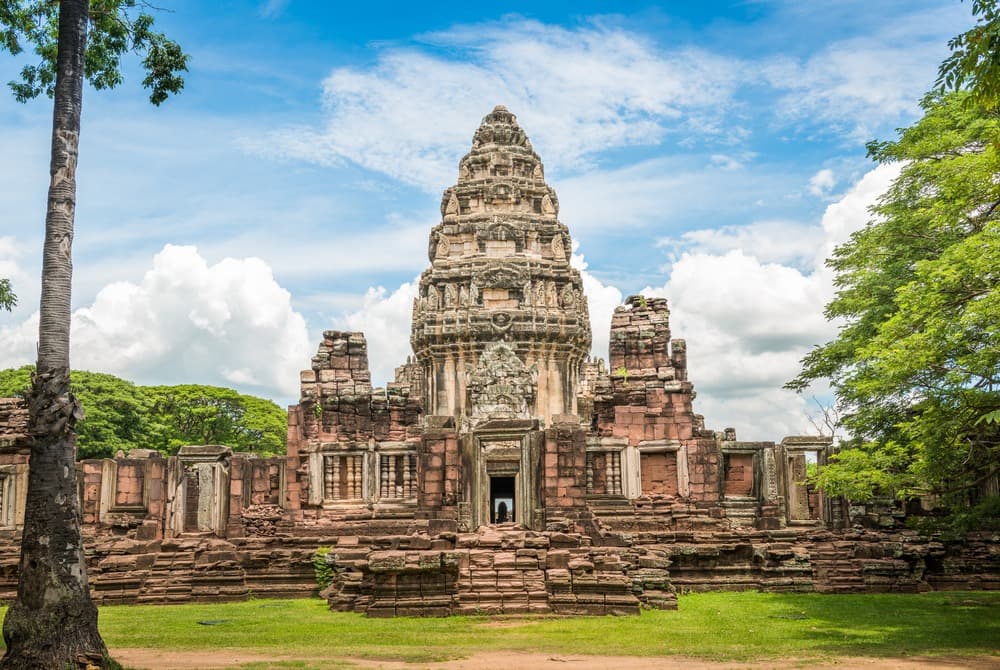
The Prasat Hin Phimai ranks among Thailand's largest Khmer temple complexes. Located in Nakhon Ratchasima province, right in the heart of Phimai town, the site contains three monumental prangs, Hindu and Buddhist bas-reliefs, and a sandstone enclosure reminiscent of Angkor's architecture.
Why Visit Prasat Hin Phimai
The sanctuary offers a rare case in Southeast Asia: a Buddhist place of worship built in a distinctly Hindu style. Travelers interested in archaeology will find a well-preserved complex with logical cardinal organization, and significantly fewer crowds than major temples in the north or central plains. The similarities with Angkor — the dimensions of the prangs, sculptural motifs, three-tower structure — make it a worthwhile stop for understanding the western expansion of the Khmer Empire.
The site lends itself to a leisurely visit over two to three hours and easily fits into a cultural itinerary in the Isaan region.
Temple History
Isaan was annexed by the Khmer Empire around the year 1000. To consolidate his authority, King Rajendravarman II promoted the Devaraja cult, presenting himself as the human incarnation of Shiva, a divinity widely venerated by his subjects. The temple was completed toward the end of the 11th century, during a period when Phimai served as an administrative and religious center linked to Angkor by an imperial road.
Official records date the foundation to the early 11th century, though artifacts discovered on site suggest older occupation: Sanskrit tablets and a statue of Shiva mounted on the bull Nandi are dated approximately 500 years earlier than the official founding. This earlier dating remains debated among scholars.
The complex underwent several construction phases. Under Jayavarman VII, in the late 12th century, the site was restructured and completed with new structures. The main sanctuary, long associated with Hindu worship and later Mahayana Buddhism, reflects the region's religious transition.
Restoration work conducted between 1964 and 1969 benefited from joint financial support from France and Thailand. Site management is now entrusted to the Royal Department of Fine Arts, and research continues. The name Prasat Hin Phimai derives from Vimayapura, "City of Vimaya." The site is also known as the Phimai historical park.
What to See on Site
Viewed from a distance, the complex forms an ensemble of towers whose pointed roofs symbolize Mount Meru, the sacred Hindu mountain. The façade combines sandstone, brick, and laterite, with remarkable sculptural work.
The Enclosure and Naga Bridge
The temple is organized around four gates oriented toward the cardinal directions, framed by sandstone walls. The main gate, to the south, is called Pratu Chai ("Gate of Victory"); it once opened directly onto the imperial road leading to Angkor. Passage is made via a bridge of nagas guarded by carved lions, a classic Khmer architectural motif where polycephalous serpents symbolically accompany the Buddha in meditation.
The Prang Prataan, Main Sanctuary
At the center of the complex, the Prang Prataan rises 32 meters and forms the masterpiece of the entire complex. Built in white sandstone, it houses a mandapa as well as a statue of Buddha protected by Mucalinda, the prince of the nagas. The pediments and cornices recount episodes from the Hindu cycle — Shiva's cosmic dance, scenes from the Ramayana — while the interior niches feature Buddhist representations. This iconographic layering illustrates the sanctuary's hybrid character.
The Prang Brahmadat
Of square plan and built in laterite, the Prang Brahmadat was erected under Jayavarman VII in the late 12th century. It rises to half the height of the main tower and marks the site's expansion during this reign of a great builder.
The Prasat Hin Daeng
To the left of the central sanctuary, the Prasat Hin Daeng is distinguished by its red sandstone and 15-meter height. Its construction is attributed to Suryavarman II. The chapel originally housed a Shiva lingam, later replaced by Buddha statues by inhabitants of Khorat, concrete evidence of the site's progressive religious shift.
Practical Information
The historical park can be visited in half a day. Plan for 1.5 to 2.5 hours on site depending on your interest in sculpture and epigraphy. Admission is charged at a modest rate, higher for foreign visitors; it's best to check current conditions with the Department of Fine Arts or the local tourism office before your visit. The site is open daily during daylight hours, closing in late afternoon.
A few useful recommendations: bring water, a hat, and closed-toe shoes, as shade is rare at the complex's center. Late afternoon provides favorable lighting for photography and more bearable temperatures.
When to Visit
Isaan's tropical climate makes visiting most comfortable from November to February, the dry season with moderate temperatures. Evenings can be cool: plan an extra layer for end-of-day travel. From May to October, the rainy season brings frequent showers and marked humid heat, though this doesn't make the site inaccessible.
How to Get There
Phimai is located approximately 60 km northeast of Nakhon Ratchasima (Korat), the main regional entry point. From Korat, local buses and minivans reach Phimai bus station in about an hour. From the terminal, the site is just a few minutes' walk in the town center.
Three main options from there: a songthaew for short trips, rental of a motorcycle or car to combine Phimai with other Khmer temples in the region, or a vehicle with driver, more comfortable for a day excursion from Korat or Khao Yai. Historically, the Mun River served as an access route from Angkor for Khmer dignitaries and merchants.
Nearby
Several sites usefully complement a visit to the main sanctuary:
Phimai National Museum, which houses statuary, lintels, and archaeological objects from the park and region;
Sai Ngam, a vast forest of giant banyan trees along the riverbank, a few kilometers from town;
Prasat Phnom Wan, another, more modest Khmer temple still active as a Buddhist place of worship, located on the route between Korat and Phimai.
To extend the Thai temple theme in different registers, consider Wat Mahathat and Wat Ratchaburana in Ayutthaya, or Wat Nong Wang in the northeast.
Frequently Asked Questions
Frequently asked questions
Both. The sanctuary was designed according to Khmer Hindu architectural codes (roofs evoking Mount Meru, Shiva and Ramayana iconography), but it functioned as a Mahayana Buddhist place of worship, notably under Jayavarman VII. The main statue today represents a Buddha protected by the naga Mucalinda.
Plan approximately 1.5 to 2.5 hours on the site itself. Adding the Phimai National Museum and the banyan forest at Sai Ngam, allow a half day to a full day.
Prasat Hin Phimai shares many codes with Angkor (prang structure, motifs, scale), but it predates several major Cambodian temples and functioned as a Khmer provincial capital linked to Angkor by an imperial road. Its main interest lies in this Hindu-Buddhist synthesis unique to the western Khmer province.
It's technically possible (about 5 hours' drive each way), but hardly comfortable. It's better to plan a night in Korat or Phimai to combine the visit with other Khmer sites like Prasat Phnom Wan or Phanom Rung.
The outer enclosure and temple surroundings are accessible, but access to the prangs involves crossing stone thresholds and climbing steps. The paved ground remains uneven in places.
Plan Your Trip
Prasat Hin Phimai fits naturally into an itinerary dedicated to Isaan and Thailand's Khmer heritage. To build a tailor-made itinerary integrating Phimai, Korat, and other sites in the region, explore our Thailand travel packages.
Photos
Also discover
Phra Nakhon Khiri Historical Park
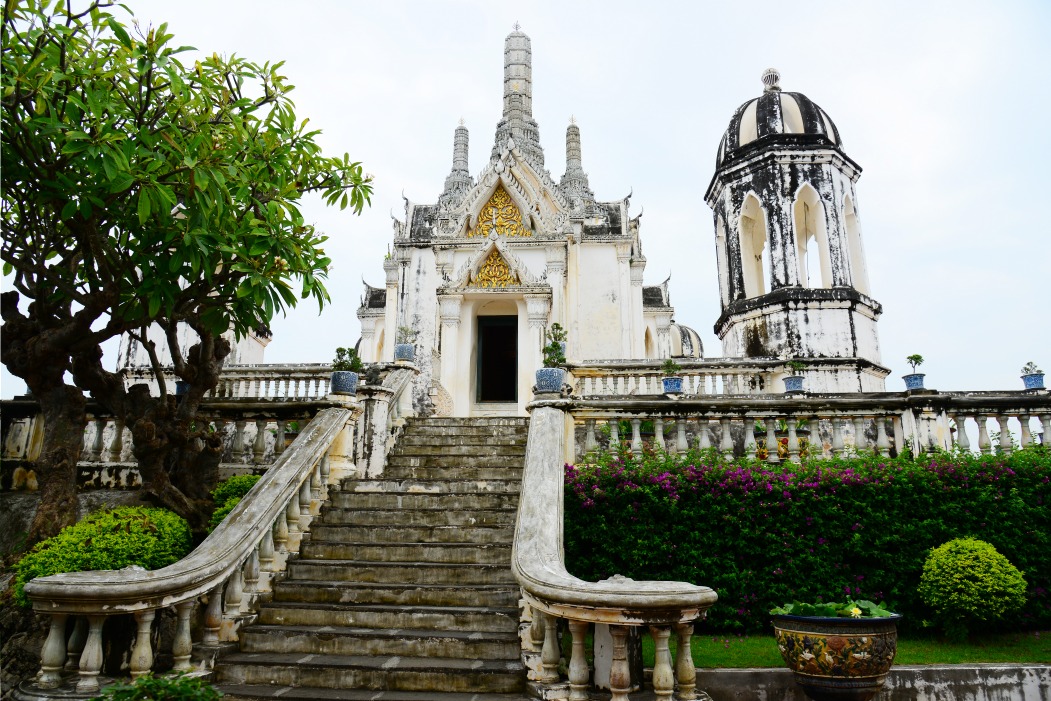
Phra Nakhon Khiri historical park, or Khao Wang, dominates Phetchaburi: a royal summer palace from 1860, temples and chedi spread across three peaks.
Ayutthaya
A UNESCO-listed former capital of the Siamese kingdom, Ayutthaya can be discovered in a day from Bangkok or savored over two days, among towering chedis, giant Buddhas and Khmer ruins.
Interested in this visit?
We can include it in your personalised itinerary.