Memorial Bridge
Memorial Bridge
Inaugurated in 1932 for Bangkok's 150th anniversary, Memorial Bridge was the first to cross the Chao Phraya. History, statues, night market and practical access.
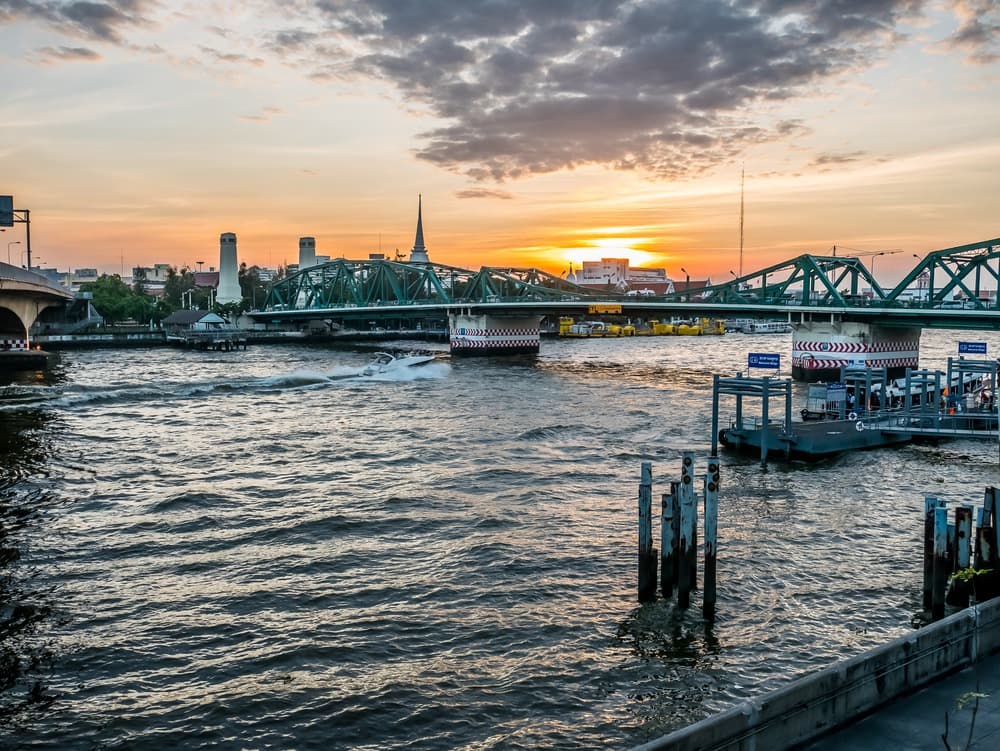
The Memorial Bridge (Saphan Phra Phutta Yodfa, abbreviated as Saphan Phut) was the first structure to span the Chao Phraya. Inaugurated in April 1932 to celebrate Bangkok's 150th anniversary, it connects the Phra Nakhon district, the historical heart of the capital, with the Thon Buri neighborhood on the opposite bank.
Why visit Memorial Bridge
Beyond its function as a transport link, the bridge encapsulates a chapter of Bangkok's modern history: the commemoration of the Chakri dynasty, the first permanent river crossing, and the opening up of Thon Buri. For visitors, it's a brief yet rich detour that combines Anglo-Saxon industrial architecture from the 1930s, monumental sculpture, and direct access to several emblematic sites of the old city.
The appeal also lies in the neighborhood's atmosphere: food markets by day, night market in the evening, the constant flow of long barges on the Chao Phraya, and an unobstructed perspective of both riverbanks.
Bridge history
The Thai name Saphan Phra Phutta Yodfa pays homage to Rama I, founder of the Chakri dynasty in 1782. The bridge's construction was part of the celebrations for Bangkok's 150th anniversary, observed during the reign of Rama VII, who presided over the inauguration ceremony in April 1932.
Design and construction
The Thai government issued an international call for proposals. The project was awarded to Dorman Long & Co. Ltd, a British company specializing in steel bridges (also known for the Sydney Harbour Bridge). The Società Nazionale Officine Savigliano, based in Italy, validated technical feasibility. Construction began on December 3, 1929.
The final structure consists of three spans, measures 230 meters long by 17 meters wide, and rises 7.5 meters above the water. It was designed as a drawbridge to preserve river traffic; the lifting mechanisms were deactivated in 1981.
A catalyst for urban development
Beyond its symbolic dimension, the bridge transformed the capital's west side. Before 1932, Thon Buri remained a poorly served suburb. The Public Works Ministry simultaneously funded the Prajadhipok Road and the Wongwian Yai roundabout, which together with the bridge formed a structuring axis that opened the west bank to development.
What to see on site
The statue of Rama I
At the entrance on the Phra Nakhon side, a monumental statue of Rama I seated on his royal throne welcomes visitors. It is the work of Corrado Feroci, an Italian sculptor based in Bangkok (known locally by the name Silpa Bhirasri). Prince Naris, son of King Mongkut, designed the ornamental garden that showcases the statue.
The bridge's architecture
The olive-green metal railings and three-span silhouette recall the aesthetic of British interwar bridges. The pedestrian walkway offers a clear view of the barges descending the Chao Phraya and, in the background, the contemporary skyline.
The equestrian statue of King Taksin
At the Thon Buri end stands the equestrian statue of King Taksin the Great, also signed by Corrado Feroci, created 22 years after that of Rama I. It marks the symbolic entrance to the former capital founded by Taksin before power was transferred to Rattanakosin.
The night market and Pak Khlong Talat
The Memorial Bridge night market sets up in the evening, typically from 8 p.m. to midnight: textiles, accessories, toys, secondhand clothing. A short distance away, Pak Khlong Talat, Bangkok's largest fresh flower market, operates nearly 24/7 and is a natural complement to your visit.
When to go
Late afternoon is the most rewarding time: raking light highlights the metal structure and opposite bank, and you can then transition to the night market once darkness falls. The dry season, from November to February, offers the most comfortable conditions for walking across the bridge. During the rainy season (June-October), plan an early evening window between showers.
Practical information
Visiting the bridge itself is free and done on foot via the designated pedestrian walkway. Allow 30 to 45 minutes for the crossing and statues, plus 1 hour if you continue to the night market or Pak Khlong Talat. Bring water, as the bridge is fully exposed to the sun during the day.
How to get there
The bridge is located at the southern edge of the historic Phra Nakhon district. Several options:
Boat: the most convenient solution. Chao Phraya Express Boats serve the Memorial Bridge (Saphan Phut) and Rajinee piers, a few minutes' walk from the bridge.
MRT: Sanam Chai station (blue line) is approximately 15 minutes' walk away, passing through Pak Khlong Talat.
Taxi or tuk-tuk: from Khao San Road or the Grand Palace, the journey typically takes between 10 and 20 minutes depending on traffic.
In the area
The bridge is part of a rich itinerary in the heart of the old city:
The Grand Palace of Bangkok, approximately 2 km to the north.
Wat Phra Kaeo, which houses the Emerald Buddha, within the Grand Palace grounds.
The National Museum of Bangkok, to contextualize the Chakri dynasty.
Wat Saket and its Golden Mount, accessible by taxi.
The Phra Nakhon district as a whole, to extend your walk through historic Bangkok.
Frequently asked questions
Frequently asked questions
Its official name is Saphan Phra Phutta Yodfa, in honor of Rama I, founder of the Chakri dynasty. Thai people commonly call it Saphan Phut.
The simplest way is to take a Chao Phraya Express Boat to the Memorial Bridge pier, or the MRT to Sanam Chai station then a 15-minute walk. Taxi and tuk-tuk are also available.
The Memorial Bridge night market typically starts around 8 p.m. and closes around midnight. Hours may vary; check locally on the day of your visit.
Planning your trip
Memorial Bridge naturally fits into a discovery of Bangkok centered on the east bank of the Chao Phraya. To build a complete Thailand itinerary, consult our tailor-made Thailand trips.
Interested in this visit?
We can include it in your personalised itinerary.