Wat Thung Si Mueang
Wat Thung Si Mueang
Active Buddhist temple in Ubon Ratchathani founded under Rama III, celebrated for its stilt library Ho Trai and its relic of the Buddha's footprint.
Wat Thung Si Mueang occupies the historic center of Ubon Ratchathani, the cultural capital of eastern Isan. This active Buddhist temple preserves a copy of the Buddha's footprint and houses one of Thailand's best-preserved stilt libraries.
Why visit Wat Thung Si Mueang
The temple holds a twofold appeal: religious, with a venerated relic brought from Bangkok in the 19th century, and architectural, thanks to its Ho Trai library built above a lotus pond. A visit requires little time and fits easily into a stop in Ubon Ratchathani, a city still rarely visited by mainstream tourist circuits. Entry is free, and the site remains frequented by worshippers, which preserves its living character rather than a museum-like atmosphere.
History of the temple
Wat Thung Si Mueang was built during the reign of Rama III (1824–1851) to house a copy of the Buddha's footprint brought from Wat Saket in Bangkok. The goal was to allow locals to venerate this relic without undertaking the long journey to the capital.
The ubosot, or ordination hall, was erected in 1842 under the supervision and financial support of the provincial governor at the time. The temple has remained an active place of worship since its foundation and attracts devotees from several regions of Thailand, particularly during major Buddhist festivals.
What to see on-site
The Ho Trai library
This entirely wooden library rests on wooden pilings planted in a lotus pond. The arrangement is not merely aesthetic: historically, it protected manuscripts from ants and termites. The multi-tiered roof is adorned with Chofa, those distinctive pointed ornaments characteristic of Thai Buddhist architecture. The exterior facades bear carved motifs, and the interior walls are decorated with religious-themed designs.
The Ho Trai preserves Buddhist Tripitaka manuscripts written on palm leaves, a writing technique used throughout Southeast Asia before the spread of printing.
The ubosot and the relic
The ubosot built in 1842 features exterior finishes dominated by white, gold, and red tones. Inside, the murals recount the life of Siddhartha Gautama, from his birth to his enlightenment. The bronze copy of the Buddha's footprint is displayed here before a large image of Buddha in lotus position. It is before this ensemble that the faithful come to bow and leave offerings.
Practical information
Temple entry is free. The site opens early in the morning and remains accessible until early afternoon; it is advisable to check current opening hours on-site or with your accommodation, as these may vary according to religious periods. Allow 1 to 1.5 hours to explore the grounds, the ubosot, and the library.
A few rules to observe:
- Dress covering shoulders and knees
- Remove shoes before entering buildings
- Do not point the soles of your feet toward Buddha statues
- Maintain silence inside worship halls
- No displays of affection in public, no smoking within the temple grounds
When to go
The period from November to February offers the most favorable conditions: moderate temperatures and low rainfall. The rainy season, from June to October, can complicate access to certain regions of Isan, but the temple itself remains visitable year-round. Early morning provides better light for photographing the Ho Trai and its reflection in the pond.
How to get there
Ubon Ratchathani has an international airport with daily connections to Bangkok, and occasional connections to Phuket and Chiang Mai. The city is also served by the Bangkok–Ubon Ratchathani railway line, which is a popular mode of transport for discovering Isan.
Once there, songthaew lines 2, 3, 8, and 12 serve the temple and stop in front of the main entrance. Parking is available nearby.
Nearby attractions
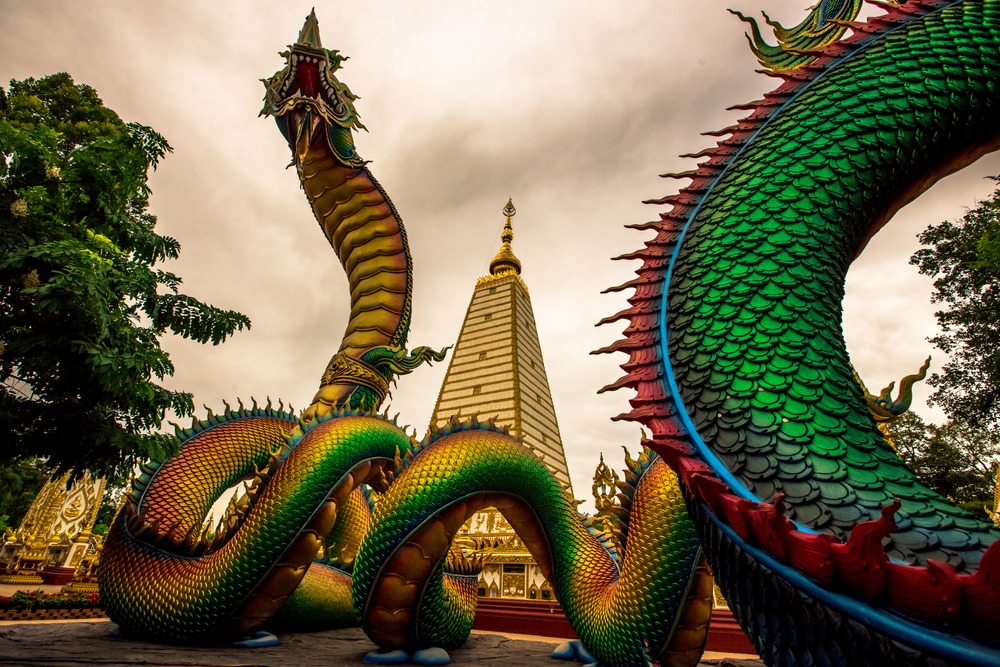
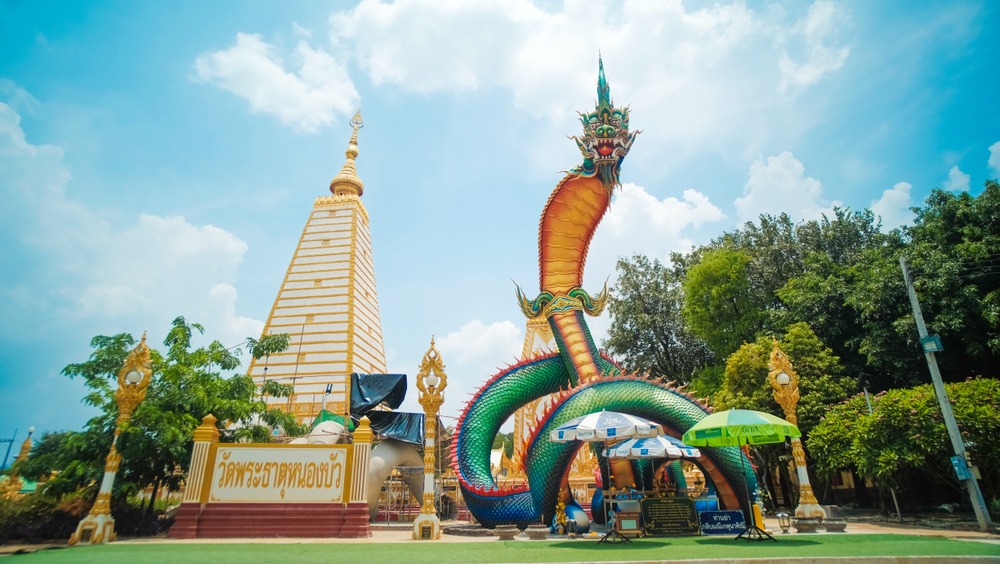
- Wat Phra That Nong Bua, a stupa inspired by Bodhgaya temple
- Sam Phan Bok, rock formations on the Mekong
- Mun River, waterway that flows through the province
- Prasat Hin Phimai, Khmer sandstone complex in pink
Frequently asked questions
Allow 1 to 1.5 hours to explore the grounds, observe the Ho Trai library, and view the murals in the ubosot.
Yes, access to Wat Thung Si Mueang is free. Donations are welcome inside, as in most Thai temples.
The main grounds are level, but the stilt library Ho Trai is accessed by a narrow wooden staircase, which is not well-suited for wheelchairs.
To incorporate Ubon Ratchathani and Wat Thung Si Mueang into a complete Isan itinerary, consult our Thailand travel suggestions.
Photos
Interested in this visit?
We can include it in your personalised itinerary.