The Golden Triangle
The Golden Triangle
At the junction of Thailand, Laos and Myanmar, the Golden Triangle brings together Lanna temples, ethnic villages and panoramic views over the Mekong.
In the remote northern reaches of Thailand, the Golden Triangle designates the zone where Thai, Lao and Burmese borders converge, around the confluence of the Mekong and Ruak rivers. Once closely associated with opium cultivation, this mountainous region is now readily accessible and offers Lanna temples, ethnic villages and riverside panoramas.
Why visit the Golden Triangle
Three elements make this place singular. First, geography: three countries face each other across the Mekong, with Chiang Saen on the Thai side, Tachilek in Myanmar and Huay Xai in Laos. Next comes history, marked by the opium trade that shaped the region's clandestine economy for decades. Finally, human diversity: Karen, Akha, Lahu, Lisu and Hmong peoples inhabit the valleys and highlands, each with their own language, dress and social organization.
The Golden Triangle lends itself to a three to five-day stay combining temple visits, navigation on the Mekong, hiking and encounters in highland villages.
History: from the opium trail to tourism
Poppy cultivation was introduced to the region around the mid-1920s. The drug was exchanged for gold or weapons, and China's Yunnan province long controlled a significant share of the trade. Following the Chinese Communist Party's rise to power, Yunnan was "cleansed": traffickers pursued, users sent to rehabilitation, farmers forced to replace poppies with other crops. The production hub then shifted southward, to the highlands of the Golden Triangle.
From the second half of the 20th century onward, the zone ranked among the world's principal opium-producing regions, alongside the Afghan Golden Crescent. Since then, public policies have curbed poppy cultivation on the Thai side, where tea, corn and coffee are expanding. In Myanmar, however, poppy cultivation remains dominant in several border states.
What to see and do
The Golden Triangle Viewpoint
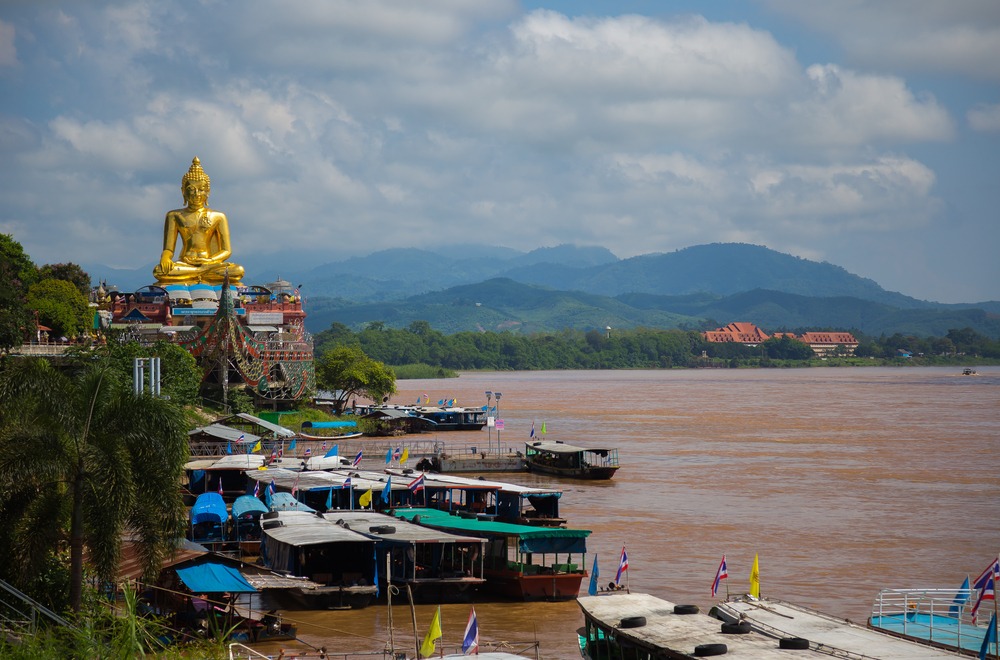
Located in Sop Ruak, a few kilometers north of Chiang Saen, this vantage point is the most frequently visited observation point. The boat-shaped building, topped by a golden Buddha in lotus position, faces the Mekong. The view encompasses simultaneously the Thai, Lao and Burmese shores.
Wat Phra That Doi Pu Khao
Just behind the Viewpoint, this Buddhist monument ranks among the oldest in the region. It perches on a rocky spur from which one overlooks the river confluence and surrounding forests. The ascent is made on foot via a short but steep staircase.
Wat Phra That Chedi Luang
Located near Chiang Saen's National Museum, the complex was built around 1331 then enlarged 184 years later. The main stupa, with a circular base roughly 24 meters across, illustrates Lanna architecture through its slender, conical silhouette. The site, partially ruined, retains a sober atmosphere.
Wat Phra That Pha Ngao
South of Chiang Saen, this temple takes its name from a white stupa built atop a rocky outcrop. It houses an original library: tales, poems and Buddhist treatises from various countries are arranged in wooden chests, each nation possessing its own sculpted chest. Villagers make pilgrimages here when they fall ill, tradition holding that the relics promote recovery.
Wat Phra Chao Lan Thong
Founded over 530 years ago, this temple distinguishes itself through its Viharn with a three-segment roof, characteristic of northern Thai architecture. Access is via a staircase bordered by nagas. Inside, a 1.2-ton Buddha occupies the center of the hall.
Chiang Saen National Museum
Its collection spans nearly 15,000 years of human occupation in the region: prehistoric ceramics, musical instruments, paintings, Buddhist statuary. It makes a good introduction before visiting the temples.
The Opium Museum
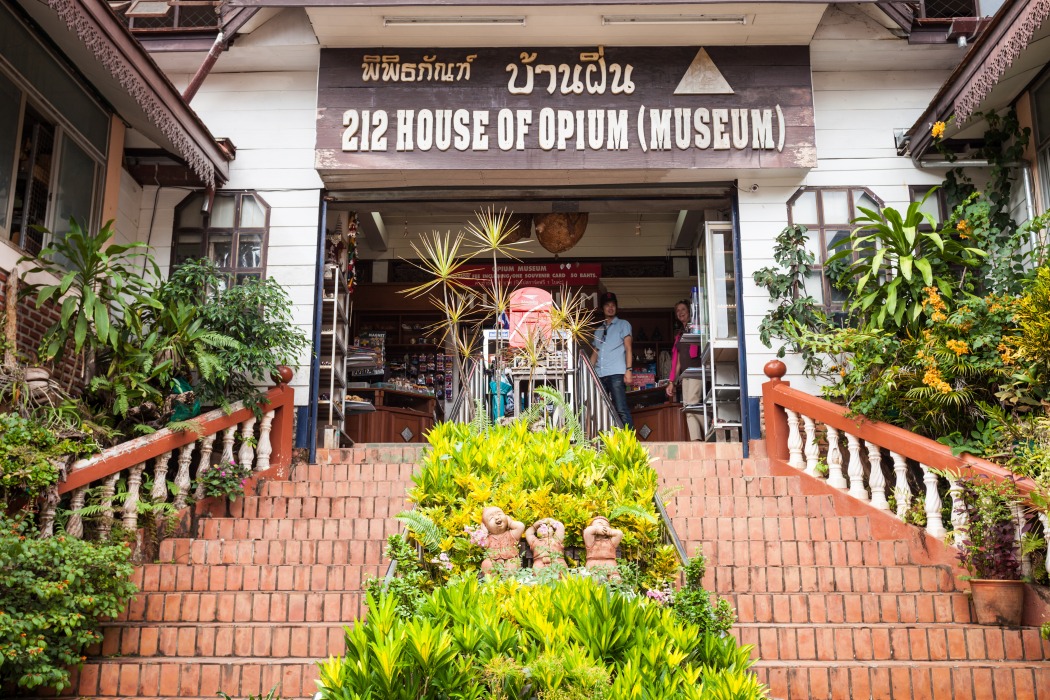
Located in the village of Sop Ruak, roughly 2 kilometers from the Viewpoint, the Opium Museum traces the stages of poppy cultivation and refinement, the history of major traffickers and drug-fighting policies. The visit, educational in nature, requires one to two hours.
Mekong River cruise
Several embarkation points offer boat outings lasting one to three hours. The journey allows you to sail along the Lao and Burmese shores, observe riverside villages and, depending on stops, visit a border market or artisanal workshop.
Ethnic villages
The region concentrates five main groups, each with its own landmarks:
- Karen: present in the region since the Mon-Khmer empire era, terraced rice farmers and betel chewers. Some were Christianized by British missionaries in the 20th century without abandoning shamanic practices. The village of Ruamit is among the most accessible.
- Akha: bamboo huts, slash-and-burn agriculture, women in brightly colored embroidered dress. Several villages can be visited north of Chiang Rai, between Mae Chan and Doi Mae Salong.
- Lahu: former tiger hunters, organized as a settled rural society. They wear black or yellow embroidered capes and celebrate each New Year with a tribute to Aue Za, marked by animal sacrifice. Ethnologist David Bradley dedicated the work Lahu Dialects (1999) to them.
- Lisu: descendants of Tibetan immigrants, they share cultural traits with the Hans of Yunnan. Jewelry worn by women signals social or marital status.
- Hmong: their villages are found mainly around the Lao border.
Favor visits guided by local guides, which ensure fair compensation for host families and prevent "zoo" visits.
When to visit
The rainy season spans April to November, with frequent showers and sometimes impassable trails. The cool and dry season, December to February, is most favorable: moderate temperatures, clear skies over the Mekong, hiking trails passable. March and early April mark a hot and misty season, sometimes hazy from agricultural burning.
Practical information
Allow three to four days to cover the essentials: Chiang Saen and its temples, the Viewpoint and Opium Museum, a half-day boat trip on the Mekong, a day's hike to an ethnic village. Plan for clothing that covers the body for temples, hiking shoes and a raincoat in the wet season.
The region is safe for travelers today. Border crossings to Laos (via Huay Xai) and Myanmar (via Tachilek) are possible according to current regulations, which should be verified before departure.
How to get there
The entry point is Chiang Rai, served by flights from Bangkok and Chiang Mai. From Chiang Rai, regular buses reach Chiang Saen in roughly one and a half to two hours. The Sop Ruak Viewpoint lies about ten kilometers north of Chiang Saen.
To explore the region at your own pace, renting a scooter or car from Chiang Rai remains the most flexible option. Local agencies also offer guided excursions lasting one to three days combining temples, cruises and villages.
Nearby
- Chiang Saen — ancient Lanna capital on the Mekong, the logical starting point for the zone.
- Mae Salong — village of Kuomintang descendants, high-altitude tea plantations.
- General Tuan's tomb — historical memorial linked to the settlement of Chinese nationalist troops.
- Doi Din Dang pottery workshop — contemporary ceramics inspired by Japanese techniques.
- Ban Tham Pha Tong — natural site and caves north of Chiang Rai.
Frequently asked questions
Frequently asked questions
Three to four days are sufficient to explore Chiang Saen and its temples, take a Mekong cruise and visit at least one ethnic village. Add a day for Mae Salong or a border excursion.
Yes, on the Thai side the region is safe and well-serviced. For hikes to remote villages, it's best to go through an agency or local guide familiar with the terrain.
December to February, during the cool and dry season. Avoid the rainy season (April-November) and the agricultural burning period (March-early April) which reduces visibility.
Cross-border excursions are possible via Huay Xai (Laos) and Tachilek (Myanmar), but visa rules and restrictions evolve regularly. Check current conditions before departure.
The quickest is a flight to Chiang Rai, then a bus or car to Chiang Saen. Allow roughly half a day of door-to-door travel.
Plan your trip
The Golden Triangle integrates naturally into an itinerary in northern Thailand, as a complement to Chiang Mai and Chiang Rai. To build a tailor-made program, consult our travels in Thailand.
Photos
Interested in this visit?
We can include it in your personalised itinerary.