Wat Intharawihan
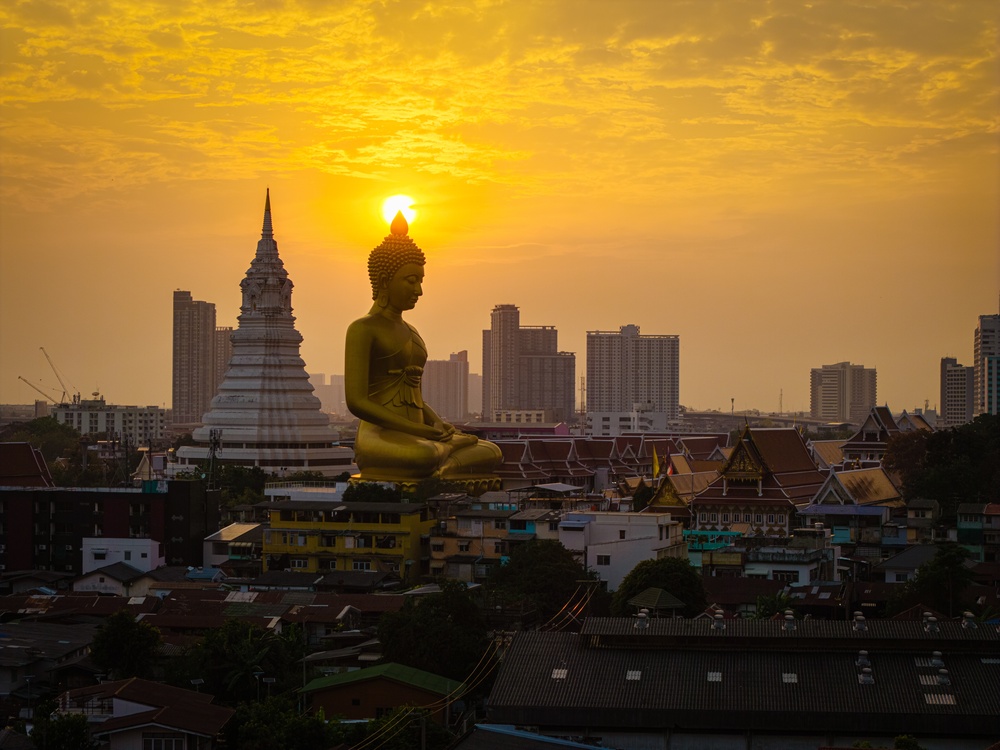
Wat Intharawihan, in the Banglamphu district of Bangkok, shelters a 32-meter standing Buddha statue adorned with golden glass mosaics. An active, authentic temple rarely overwhelmed by tourists, just steps away from Khao San Road.
Wat Intharawihan is a Buddhist temple in the Banglamphu district, north of Bangkok's historic center. It houses one of Thailand's largest standing Buddha statues, rising approximately 32 meters high, covered with golden glass mosaics. Less visited than temples on the standard tourist circuit, it remains an active place of worship, frequented primarily by Thai devotees.
Practical Information at a Glance
- Entrance : free
- Dress code : shoulders and knees must be covered; sarongs are available for loan at the entrance
- Shoes : must be removed before entering sacred buildings
- Recommended duration : 30 to 45 minutes
- Access : Banglamphu district, a few minutes' walk from Khao San Road
What You'll See
The standing Buddha statue (Luang Pho To) dominates the entire temple complex. At 32 meters tall, it is inlaid with small golden glass tiles that shimmer in the light. At its base, devotees leave offerings and jasmine garland chains. The complex also comprises an ubosot (ordination hall), chedis, and several secondary pavilions decorated with frescoes.
History and Context
The temple dates back to the Ayutthaya period, though its current configuration is primarily from the nineteenth century. The great standing Buddha statue was constructed during the reign of Rama IV, then completed under Rama V. It draws inspiration from a revered statue at Wat Indraviharn in Calcutta, brought to Thailand as a model of devotion. The temple belongs to the Dhammayut order.
Highlights of the Visit
Luang Pho To, the Giant Buddha
The statue is the heart of the site. From ground level, you can discern the details of the golden mosaic and the serene face of the Buddha. It is possible to ascend inside the statue via an interior staircase to reach the level of the navel, offering views across the complex.
An Atmosphere of Devotion
Unlike highly touristy temples, Wat Intharawihan remains a place of daily practice. Early in the morning, monks recite prayers and devotees circle the statue bearing lotus flowers. This authentic atmosphere is rare in central Bangkok.
Etiquette and Visit Rules
- Cover shoulders and knees; avoid transparent clothing.
- Remove shoes before entering any enclosed building.
- Speak in a low voice and do not turn your back to a Buddha statue for photographs.
- Women must not touch monks or hand objects directly to them.
- Do not point your feet toward statues or monks.
Photography Tips
Morning light (before 9 a.m.) is ideal: it illuminates the golden façade of the statue without backlighting. To frame the entire statue, step back to the entrance of the complex. The mosaic reflections are particularly photogenic in late afternoon. Photography is permitted in outdoor spaces; check restrictions inside enclosed buildings.
Location and Access
The temple is located in the Banglamphu district of Bangkok, a few hundred meters north of Khao San Road. It is accessible on foot from the Phra Athit pier (express boat on the Chao Phraya River). The district is also served by several bus lines. No BTS or MRT station is directly nearby.
Nearby
- Khao San Road — the lively heart of the backpacker district, a few minutes' walk away.
- Wat Bowonniwet — royal temple of the Dhammayut order, where King Rama IX was ordained as a monk.
- Grand Palace and Wat Phra Kaew — major royal complex, accessible by boat from Phra Athit.
- Wat Pho — temple of the reclining Buddha, south of the Grand Palace.
- Fort Phra Sumen — remnant of Bangkok's fortifications, along the river.
Frequently asked questions
Entrance is free. Proper dress is mandatory, however.
Shoulders and knees must be covered. Sarongs are generally available at the entrance if your clothing is not suitable.
An interior staircase allows you to climb to the level of the statue's navel. Check on-site whether access is open during your visit.
The temple is easily visited with Khao San Road and Wat Bowonniwet on foot. For the Grand Palace or Wat Pho, take the express boat from Phra Athit pier, a few minutes' walk away.
Early morning is the quietest time and best for photography. The temple is less frequented by tourists than major central sites, but lively with devotees in the morning.
Photos are allowed in outdoor spaces. Inside enclosed buildings, check prohibition signs on-site before photographing.
Nearby
Interested in this visit?
We can include it in your personalised itinerary.